In-Depth Feature
The Sámi: Europe’s Last Indigenous People
Across four nations and ten thousand years, the people of Sápmi have endured, and are now fighting for their future on their own terms
Sápmi: A Land Without Borders
Long before Norway, Sweden, Finland, and Russia drew their lines across the northern wilderness, the Sámi people called the entire region home. Their name for this territory, Sápmi, predates every modern state that now governs it. Stretching from the Norwegian Sea coast in the west to the Kola Peninsula in the Russian east, Sápmi spans some 400,000 square kilometres of tundra, boreal forest, mountain plateau, and Arctic coastline.
The heart of Sámi country lies above the Arctic Circle. In Norway, communities are concentrated across the vast northern counties of Finnmark, Troms, and Nordland, with Karasjok considered the unofficial Sámi capital and home to the Norwegian Sámi Parliament. But Sámi people are also present as far south as the Trøndelag region, around Røros and the Femundsmarka wilderness, notably, this includes Elverum and the broader Innlandet county, where the Southern Sámi have lived for millennia.
This transnational character is fundamental to understanding the Sámi. Their cultural areas, language dialects, reindeer migration routes, and kinship networks cut freely across national boundaries. The political borders, drawn by states in the 18th and 19th centuries, were imposed on a people who had never conceived of the land in such terms. Today, this division remains one of the central complications of Sámi political life.
Ten Thousand Years: A Brief History
Genetic and archaeological evidence suggests that the ancestors of the Sámi were among the very first people to repopulate Scandinavia after the last Ice Age, roughly 10,000 years ago. The earliest written accounts of a people resembling the Sámi appear in the works of Tacitus (AD 98) and Procopius (AD 550), both describing a northern people living by hunting and fishing.
Through the Viking Age (AD 800–1100), the Sámi maintained an extensive trading network, exchanging furs, dried fish, and reindeer products with Norse chieftains and merchants. Sámi sacrificial sites in Swedish Lapland have yielded metal objects from across the Nordic world, Russia, and even Western Europe, testament to the reach of their exchange economy. It was during this era, and particularly from the 17th century onward, that semi-nomadic reindeer herding became the defining livelihood for many Sámi groups, replacing or supplementing earlier reliance on wild reindeer hunting.
“For long periods of time, the Sámi lifestyle reigned supreme in the north because of its unique adaptation to the Arctic environment, enabling Sámi culture to resist cultural influences from the south.”
The expansion of Scandinavian state power brought catastrophic disruption. From the 16th century, Lutheran and Catholic missionaries moved aggressively to eradicate the old Sámi shamanistic religion, burning drums, outlawing the joik (traditional song), and prosecuting practitioners as sorcerers. The 1751 Strömstad Treaty between Sweden and Norway, sometimes called the “Sámi Magna Carta”, did formally acknowledge Sámi rights to cross borders with their reindeer, but those rights were progressively eroded over the following two centuries.
The 19th and early 20th centuries brought the most concerted cultural assault. In Norway, the policy of Norwegianisation (fornorsking) was pursued with particular vigour from around 1900 to 1940: Sámi children were forbidden from speaking their language at school, anyone wishing to buy state land in Finnmark had to prove knowledge of Norwegian, and the entire apparatus of the state was mobilised to replace Sámi identity with a Norwegian one. Sweden and Finland pursued broadly similar assimilation programmes.
The turning point came in the 1970s and 1980s, catalysed in Norway by the “Alta controversy”, a mass protest against the damming of the Áltaelva river in Finnmark that would have flooded Sámi villages and reindeer pastures. The movement galvanised international attention and Sámi solidarity across borders, and ultimately led to the establishment of the Norwegian Sámi Parliament (Sámediggi) in 1989, followed by Finland’s in 1973 (reconstituted under new legislation) and Sweden’s in 1993. Norway formally apologised in 1999 for its assimilation policies. Sweden launched a Truth and Reconciliation Commission in 2021, still ongoing.
Culture, Language & the Living Arts
The Sámi are not a single homogeneous group. Across Sápmi, there are at least nine surviving Sámi languages, mutually unintelligible across the full span, though adjacent dialects are generally comprehensible to one another. Northern Sámi is the most widely spoken, with around 15,000–25,000 speakers; others, such as Akkala Sámi, had by the early 2020s only a single living speaker. Language revitalisation is a central cultural and political priority, but the legacy of forced assimilation means fewer than half of Norwegian Sámi speak a Sámi language today.
Joik, the traditional vocal art form, is perhaps the most immediately striking element of Sámi culture for outside listeners. A joik is not a song about a person, place, or animal: it is understood to be that entity, an act of summoning and embodiment. Suppressed for generations as a relic of shamanism, joik has undergone a powerful renaissance since the 1980s and now appears in everything from traditional settings to electronic fusion and contemporary pop.
Duodji, the traditional craft tradition, encompasses weaving, embroidery, leatherwork, woodcarving, and bone and antler art. Rooted in an ethic that every object should primarily serve a practical purpose, duodji objects are simultaneously tools and works of art. The Sámi Duodji label certifies authentically Sámi-made handicraft, an important protection in a region where tourist shops frequently sell counterfeit “Sámi” goods made by non-Sámi producers.
Reindeer herding, though today practised professionally by only around 10% of the Sámi population, remains the cultural and symbolic heart of Sámi identity. The roughly 3,000 herders in Norway, 2,800 in Sweden and comparable numbers elsewhere maintain an intimate knowledge of the land, weather, and animal behaviour accumulated across generations. Bidus, a slow-cooked stew of reindeer, carrots, and potatoes, is emblematic of a cuisine built on what the land provides.
Sámi spirituality, in its traditional form, was polytheistic and animistic, deeply interconnected with the natural world. The noaidi (shaman) served as an intermediary between the human and spirit realms, using a drum (runebomme) to enter trance states. Most Sámi today are nominally Lutheran or Eastern Orthodox, but there is a growing revival of interest in traditional spiritual practices, and the sun-and-moon symbolism of the shaman’s drum lives on in the design of the Sámi flag.
The Gákti: Clothing as Identity
The traditional Sámi garment is called the gákti (in Northern Sámi), or kofte in Norwegian. Far more than protective clothing, it is a precise visual language encoding the wearer’s regional origin, family lineage, gender, and marital status. In the Kautokeino tradition, for instance, a belt with square silver buttons indicates a married person; round buttons signal an unmarried one. The hat, cut of the tunic, and specific embroidery patterns further localise the wearer to a particular community or even a specific family.
Traditionally sewn from reindeer hide using sinew thread, the gákti today is more commonly made from wool, cotton, or silk, often in vivid combinations of red, blue, green, yellow, and white. Women’s gákti typically consist of a dress, a fringed shawl, and boots of reindeer fur or leather with the characteristic curled toe (nutukas). Men’s gákti are generally shorter at the hem. Silver jewellery, particularly the risku or solju brooch, often shaped like the sun and decorated with tiny silver plates, is a crucial finishing element.
The gákti was worn daily until the mid-20th century, when both the pressure of assimilation policies and the availability of cheap Western clothing pushed it toward ceremonial use. Since the 1970s, it has re-emerged as a powerful symbol of cultural pride and political assertion. Sámi politicians wear their gákti to parliamentary sessions; protesters wore them outside Oslo government buildings during the Fosen wind farm demonstrations in 2023. To wear the gákti of a cultural area to which one does not belong, or for non-Sámi to wear it as a costume, is considered a serious act of cultural appropriation.
The Flag of Sápmi
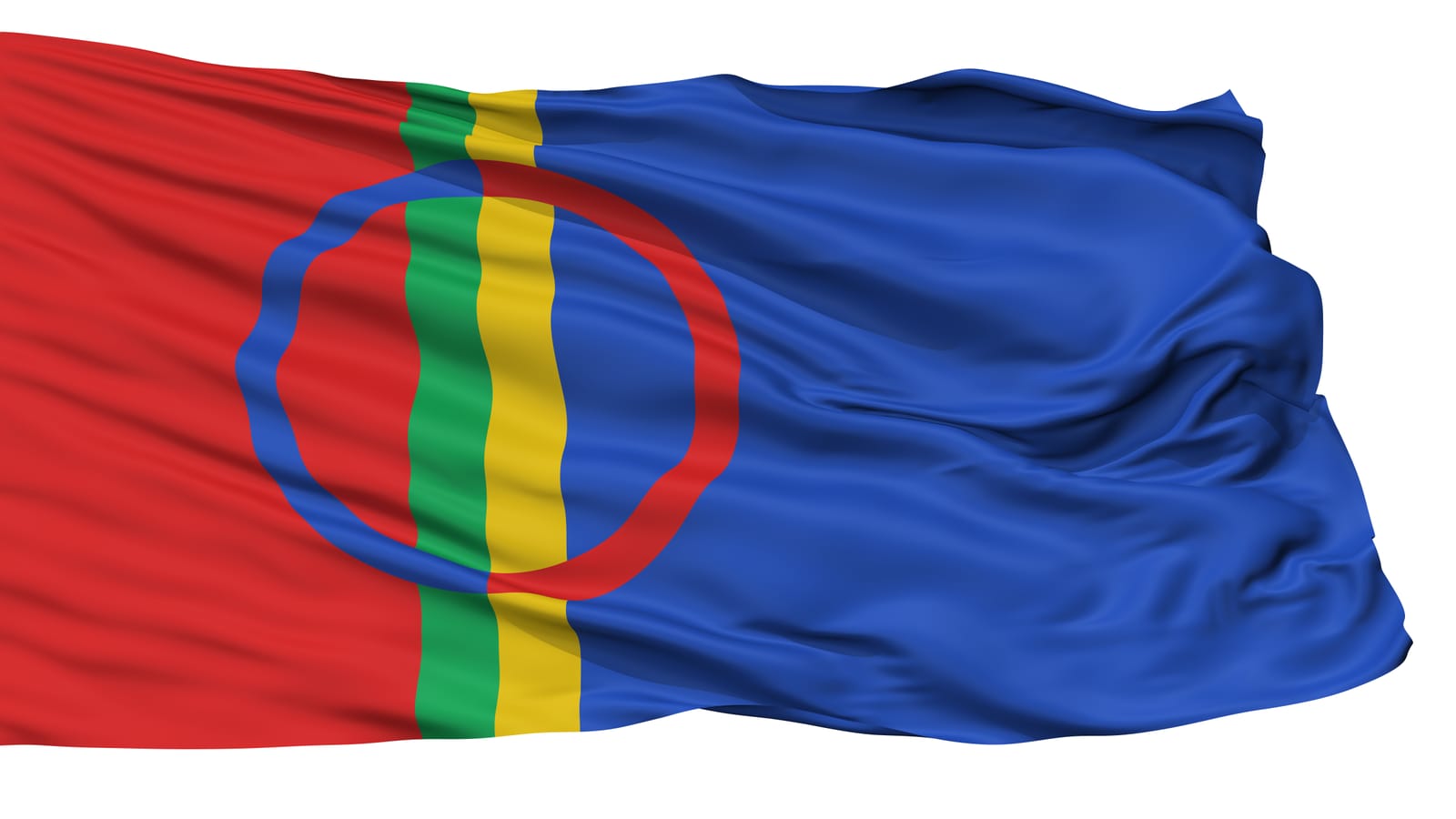
The Sámi flag was formally adopted on 15 August 1986 at the 13th Nordic Sámi Conference in Åre, Sweden, where it was chosen by unanimous vote from over 70 submitted designs. The winning design was created by Coast Sámi artist Astrid Båhl from Ivgobahta (Skibotn) in Troms county, Norway.
Båhl built on an earlier unofficial flag by artist Synnøve Persen (1977), adding the colour green, common in South Sámi gákti, and the iconic circular motif derived from the sun-and-moon symbols found on traditional Sámi shamanic drums. Her design was also inspired by the ancient Sámi poem Päiven Pārne (“Sons of the Sun”), recorded by the South Sámi clergyman Anders Fjellner in the mid-1800s from a joik tradition, which describes the Sámi as children of the union between the sun and a northern giantess.
Notably, the flag was deliberately designed to differ from all Nordic cross flags, it contains no cross, aligning instead with shamanic and cosmic symbolism. In 2003, Norway granted the flag official status, requiring all municipalities to fly it on 6 February, the Sámi National Day, which commemorates the first pan-Sámi congress held in Trondheim in 1917.
The Sámi Population Today
No precise census figures exist for the Sámi population because ethnicity is not formally registered in Finland, Norway, or Sweden. Estimates range from 50,000 to 100,000 across all four countries, with the uncertainty reflecting both mixed heritage and varying criteria for identification. The table below draws on the best available estimates from IWGIA, UN Rapporteur reports, and national Sámi parliamentary data.
| Country | Est. Population | Political Situation |
|---|---|---|
| Norway 🇳🇴 | 50,000–65,000 | Recognized under constitution; Finnmark Act (2005) governs land rights; wind farm conflicts ongoing |
| Sweden 🇸🇪 | 20,000–40,000 | National minority status (2010); Truth Commission underway (2021–2026); ILO 169 not ratified |
| Finland 🇫🇮 | 8,000–10,000 | Ongoing land rights disputes; UN rulings (Oct 2024) criticised Finland’s permitting practices; ILO 169 not ratified |
| Russia 🇷🇺 | 1,500–2,000 | Limited political space; indigenous advocacy and NGO activity heavily restricted since 2022 |
| Total | ~80,000–100,000 | UN Declaration on Rights of Indigenous Peoples supported by Norway, Sweden, Finland (2007) |
The Present Struggle: Green Transition vs. Indigenous Rights
The most urgent flashpoint in contemporary Sámi politics is the collision between their territorial rights and Europe’s drive to secure critical raw materials for the green energy transition. The irony is stark: the Sámi, among the Arctic peoples most acutely impacted by climate change, with warming occurring nearly four times faster in their region than the global average, are now expected to surrender their remaining land to supply the minerals that will power electric vehicles and wind turbines for the rest of Europe.
In Norway, the Fosen wind farm case became a cause célèbre. Norway’s Supreme Court ruled unanimously in 2021 that the construction of Europe’s largest onshore wind farm on Fosen peninsula had violated the rights of two Sámi reindeer-herding communities under international law, as it destroyed their winter pastures. The government nonetheless refused to halt construction, prompting sit-in protests at the Ministry of Petroleum and Energy in February 2023, joined by Sámi youth and Norwegian environmental activists.
In Sweden, state-owned mining giant LKAB has operated in the Kiruna region for over 130 years, displacing Sámi communities and severing reindeer migration routes. In January 2023, LKAB announced the discovery of Europe’s largest deposit of rare earth elements directly beneath ancestral Gábna and Laevas Sámi herding territory. The EU’s Critical Raw Materials Act (CRMA), adopted by the European Parliament in December 2023, further accelerated pressure by designating Kiruna-area projects as “strategic,” imposing fast-track permitting timelines. The Sámi Council issued a statement in March 2025 calling the EU’s approval of multiple mining projects on Sámi lands “a devastating betrayal of Indigenous rights.”
In Finland, the UN Committee on Economic, Social and Cultural Rights and the Committee on the Rights of the Child jointly ruled in October 2024 that Finland had violated Sámi rights to culture and land by granting mineral exploration permits in the traditional territory of the Kova-Labba Siida herding community without adequate impact assessments or free, prior, and informed consent.
In Russia, the situation is categorically different and far grimmer. The Russian Sámi have no formal legal recognition as an indigenous minority, and the space for civil society advocacy has effectively collapsed since the 2022 invasion of Ukraine. International cooperation, including with the broader Sámi Council, has been severed, and the Kola Sámi are largely invisible in contemporary policy discussions.
“The Sámi carry a double burden: they are among the people most affected by climate change, and they are expected to carry the burden of mitigation by allowing further encroachments on their remaining, already limited land.” — IWGIA, 2024
Despite these pressures, Sámi political and cultural life is experiencing a genuine renaissance. The three Sámi parliaments collaborate through the Sámi Parliamentary Council, established in 2000. The Sámi University of Applied Sciences in Kautokeino provides higher education with Sámi language as the medium of instruction. The Sáminuorra youth organisation has become an increasingly visible force in Nordic politics. And a new generation of Sámi artists, filmmakers, designers, musicians, and academics are articulating what it means to be Sámi in the 21st century, on their own terms.
Sources & Further Reading
- Wikipedia: Sámi People — comprehensive overview with citations
- Britannica: The Sami — encyclopaedic entry on culture, language, and history
- IWGIA: Sápmi — Indigenous World Reports 2024 & 2025 — annual reports on the political and human rights situation
- Visit Norway: Experience Sami culture in Norway — cultural overview including reindeer herding and the kofte
- Sweden.se: Sami in Sweden — official overview of Sámi status in Sweden
- UN Office of the High Commissioner: Finland must respect Sámi land rights (Oct 2024)
- IUCN Netherlands: Sámi and the mining of critical minerals (2025)
- NiCHE: Gákti and its role in Sámi identity-making
- Wikipedia: Sámi Flag — full history and symbolism of the flag design
- Sámi Council (Sámiráđđi): National Symbols of the Sámi
- Milwaukee Public Museum: Ancient History — The Sami
- UN Special Rapporteur Report: The situation of the Sámi people in Sápmi
- Sáminuorra (Swedish Sámi Youth Organisation): saminuorra.se
- Nordic cooperation: The Sámi flag — Nordic Council





 English