Sunday, 17 May 2026
What is it?
Syttende mai — “the seventeenth of May” — is Norway’s national day. Not an independence day in the usual sense, not a day of military pageantry. It’s something harder to categorise: a celebration where the main characters are schoolchildren in embroidered folk costumes, and the food is hot dogs and ice cream eaten in the street. If that sounds like a slightly chaotic, very joyful Sunday, that’s about right.
In 2026, the 17th falls on a Sunday, which means Oslo and every Norwegian town will be filled with people who don’t have to be at work and have been waiting for this all year.
A brief history
The Norwegian constitution was signed at Eidsvoll, a small estate north of Oslo, on 17 May 1814. Norway had been under Danish rule for centuries; the Napoleonic Wars loosened that grip. Norwegian leaders gathered at Eidsvoll and drafted a constitution drawing heavily on American and French democratic models — a bold piece of work for its time, and still one of the oldest written constitutions still in force anywhere.
There was a catch. Norway was almost immediately forced into a union with Sweden. But the Norwegians kept their constitution and quietly, stubbornly kept celebrating the date — until the Swedish king, Karl Johan, banned the celebrations between 1820 and 1829, which probably only made people more attached to them.
The poet Henrik Wergeland delivered the first public speech marking the day in 1833. He’s also the person responsible for reframing May 17 as a children’s celebration rather than a political statement — an idea that stuck. In 1870, writer Bjørnstjerne Bjørnson (who also wrote the national anthem, Ja, vi elsker dette landet) organised the first children’s parade in Christiania, now Oslo.
Norway finally separated from Sweden in 1905. Since then, May 17 has had even more weight — not as a reminder of grievance, but as something genuinely earned.
There’s one more chapter worth knowing. During World War II, the Nazi occupation banned May 17 celebrations entirely. When the children’s parades returned in 1945, people understood them differently. You don’t need to be Norwegian to find that moving.
The day in Oslo: how it actually unfolds
Oslo is probably the most spectacular place to be, though every Norwegian town does something worth seeing.
7:00 am — A 21-gun salute fires from the Akershus Fortress. The Norwegian flag goes up on every flagpole in the country. Some people have already been up for hours. The russ — high school graduates who’ve been celebrating since mid-April — have definitely not slept.
8:00–9:30 am — Brunch. This is a serious institution (see below).
10:00 am — The children’s parade (barnetog) sets off from the Akershus Fortress main gate. Over 120 schools and 60,000 children walk up Karl Johans gate toward the Royal Palace, led by brass bands. The Palace balcony is where the royal family appears to wave to the parade — broadcast live on national television. The parade reaches Rådhusplassen (City Hall Square) by around 1:30 pm.
Noon — A second salute fires. Speeches happen across the city.
Early afternoon — The public citizens’ parade (borgertog) follows. Anyone can join.
4:00–5:00 pm — The russ parade. The graduating students get their own moment, in decorated buses and vans blasting music, wearing their customised red or blue overalls covered in patches and jokes.
Evening — Dinner, parks, restaurants. Fireworks in some cities. In Kristiansand, a jazz band plays until midnight outside the Christiansholm Fortress — free entry.
The city centre is closed to traffic all day. Public transport runs on a holiday schedule. Walk, or take the T-bane or tram.
The brunch
This deserves its own section because it’s become one of the defining rituals of the day — and it’s genuinely different from the kind of “brunch” you get at a restaurant on a normal weekend.
The traditional May 17 morning starts early, sometimes as early as 7am, with what Norwegians call a champagnefrokost — a champagne breakfast, though “champagne” is used loosely and often means Norwegian cider or prosecco. It’s not fancy. It’s a koldtbord: a spread where everyone contributes something and you stand around eating for an hour before heading out to the parade.
A proper May 17 brunch table includes:
- Smoked salmon (røkt laks) and cured meats, particularly fenalår — salted dried leg of lamb, Norway’s answer to Parma ham
- Scrambled eggs
- Flatbread (lefse) with various fillings — smoked salmon is classic, but brown cheese is also traditional
- Fresh bread
- Rømmegrøt (sour cream porridge), more common in rural areas and served with butter, sugar and cinnamon
- Kransekake — a tower cake made from almond paste, stacked in rings, decorated with small Norwegian flags. It’s sweet and slightly chewy and turns up at every significant Norwegian occasion
People gather at someone’s home, or host a neighbourhood potluck. Colleagues go to a colleague’s apartment. Expats host their own versions. The meal is the thing that happens before the parade, but it often runs long.
In Oslo, many restaurants now offer May 17 brunches — Frogner Park and the surrounding neighbourhood have become a popular area for this. Book well in advance; this is one of the busiest restaurant days of the Norwegian year.
What to wear
The bunad — Norway’s traditional regional folk costume — is everywhere on May 17. If you see someone wearing an elaborate embroidered outfit in red, black, blue, or green with silver jewellery, that’s a bunad. Each one indicates a specific region: the Hardanger bunad from western Norway is probably the most recognisable, white with intricate black and red embroidery. Men’s bunads exist too, usually knee breeches and a white shirt with a waistcoat.
A quality bunad can cost thousands of euros and takes months to make. People inherit them, save up for them, have them tailored to their region of origin. The bunad is not a costume in the sense of something you put on for one day and take off. It’s an identity statement.
If you don’t have one — which is most people outside Norway — you wear your best clothes. Suits and dresses are normal. Smart casual is fine. On this day more than any other, Norwegians dress up. You’ll feel underdressed in jeans.
A few practical notes:
- Bring layers. May in Norway can be genuinely warm and sunny, or cold and grey, sometimes within the same morning. The parade will be long and you’ll be standing outside.
- Wear comfortable shoes. You’ll be on your feet for hours.
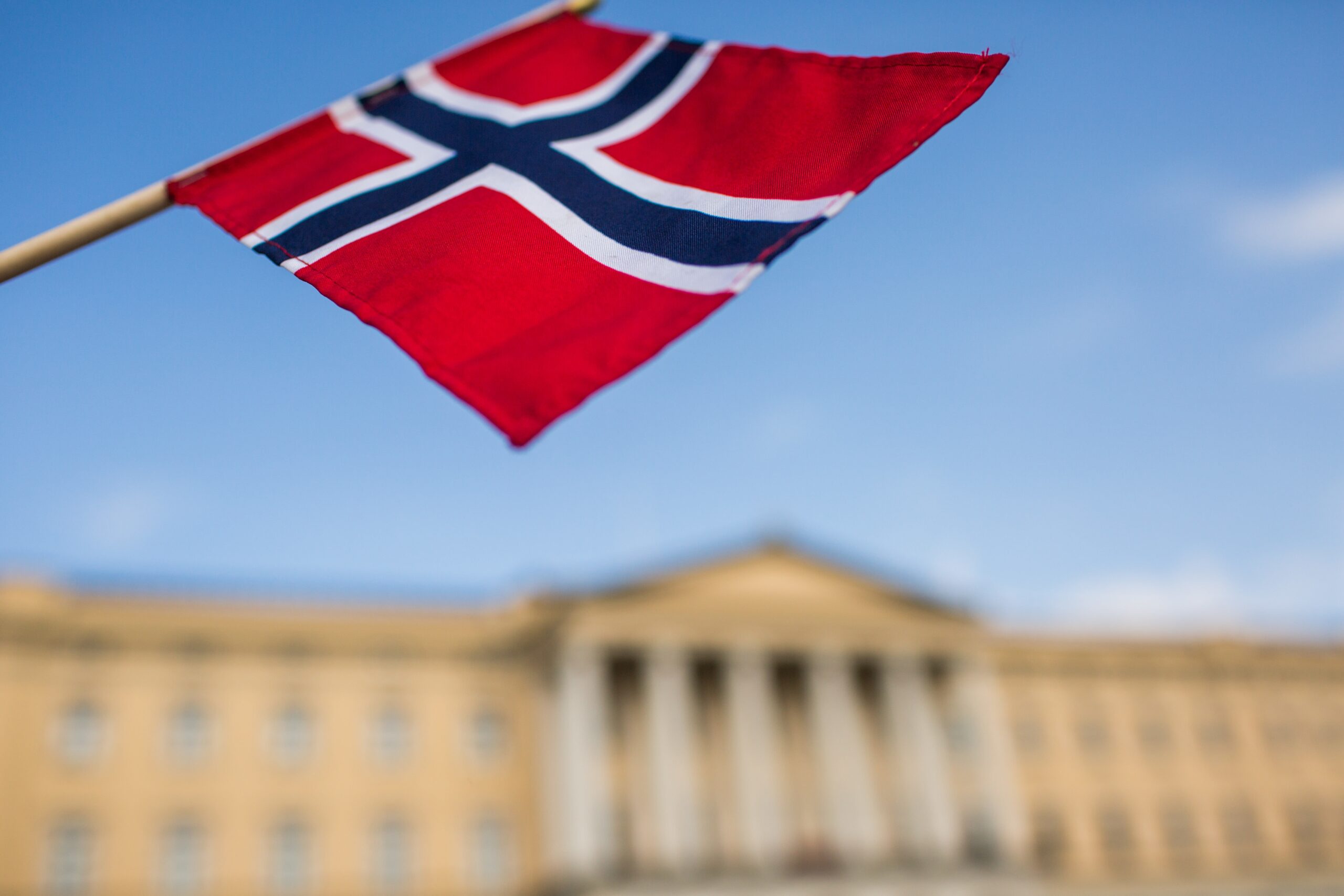
- Carry a small Norwegian flag. They’re sold everywhere in the weeks before the 17th — kiosks, petrol stations, supermarkets. Waving one during the parade is very much part of the experience.
- Red, white and blue ribbons are traditionally pinned to clothes if you’re not in a bunad.
The russ are easy to spot: red or blue overalls, heavily decorated with personalised patches, often sleep-deprived. They get their own parade and are a May 17 institution.
Food on the day
After brunch, eating becomes mobile and cheerful. Street vendors are everywhere.
Hot dogs (pølse i lompe) are the unofficial food of the day — served wrapped in a thin potato flatbread rather than a bun. Children eat as many as they want. Adults too. Then ice cream. And waffles — heart-shaped, crispy, served with sour cream and jam, or with a hot dog inside (the pøffel, which is exactly what it sounds like).
For the street-food stretch between parade and dinner, also look for: roasted almonds in paper cones, soda (children’s drinks are a serious business on this day), and increasingly, kebabs and other foods that have found their way into the celebration over the years.
In the evening, restaurants that are open will have special menus. Rømmegrøt and traditional Norwegian meat dishes come back for dinner. Sodd — a lamb broth with dumplings — is popular in Trøndelag and parts of eastern Norway. Leftovers are eaten in sweatpants. That is also a tradition.
The parades: a guide
Every Norwegian municipality holds some version of a parade. The format is almost always the same: school children in front, brass bands throughout, public citizens’ parade at the end. What differs is scale.
| City / Location | Type of Event | Approximate Time | Notes |
|---|---|---|---|
| Oslo, Norway | Full official programme: salute, children’s parade, public parade, russ parade | From 7:00 am; children’s parade 10:00 am–1:30 pm | Royal Palace balcony appearance; 120+ schools; TV broadcast. Free seated tickets available near palace |
| Bergen, Norway | Children’s parade + public parade | From 9:00 am | Parade through city centre; Bryggen waterfront area fills with spectators |
| Stavanger, Norway | Salute + children’s parade + russ + citizens’ parade + international party | From 7:00 am | British, Dutch and American schools carry international flags; international party at Bjerkstedparken |
| Trondheim, Norway | Children’s parade + public events | Morning | Parade through city centre toward Nidaros Cathedral area |
| Kristiansand, Norway | Parades + Tapto city run + fireworks + jazz until midnight | All day into midnight | Fireworks; free jazz at Christiansholm Fortress until midnight |
| Tromsø, Norway | Local parades + events | Morning | Celebrated in the Arctic; late spring sunlight |
| Stockholm, Sweden | Parade from Engelbrektsplan to Skansen | Late morning | 10,000+ participants; Det Norske Korps marching band |
| Bay Ridge, Brooklyn, NYC | Norwegian Day Parade on 3rd Avenue | Nearest Sunday to 17 May (likely 17 May 2026) | Running since 1952; one of the largest outside Norway |
| Ballard (Seattle), USA | Parade + National Nordic Museum events + live music | Parade from 6:00 pm | Claims to be largest Syttende Mai celebration outside Norway |
| Stoughton, Wisconsin | Community parade + festival | Weekend of 17 May | Competes with Seattle for “largest outside Norway” |
| Westby, Wisconsin | Four-day festival with frokost, Norwegian church service | Weekend of 17 May | Running since 1969 |
| Petersburg, Alaska | “Little Norway” festival — parade, dancers, herring toss, lefse | Weekend nearest 17 May | Norwegian settlement; strong community ties |
| Cardiff, Wales | Norwegian church parade + waffles | 17 May | Norwegian church leads the celebration |
| Orkney & Shetland, Scotland | Orkney Norway Friendship Association events | 17 May | Recognises the islands’ Norse history |
| Glasgow, Scotland | Norwegian students and friends at Murano Street Student Village | 17 May | Informal gathering |
Oslo’s children’s parade is the one most visitors aim for. Get to Karl Johans gate early — by 9:30 am if you want a decent spot. The section closest to the palace fills up fastest.
The evening
After the parades, the day splits. Some families are done. The bunads come off, leftovers come out, and by 7pm it’s quiet. Other people — particularly younger ones — are just getting started.
Parks become the centre of gravity in the late afternoon. Slottsparken (the Palace Park) and Frognerparken in Oslo fill with people on picnic blankets, often with champagne or wine. Technically, public drinking is not legal in Norway, but on May 17 the atmosphere is relaxed, and it’s generally fine as long as no one causes trouble.
Oslo restaurants that stay open — and many do — will have May 17 menus running into the evening. Book in advance; tables go weeks ahead.
The russ, having been awake since approximately the 15th, are in various states of survival. Their buses circle the city. You hear them before you see them.
In Kristiansand specifically, the city runs a tradition called Tapto — a run through the city centre — followed by fireworks, and then the jazz concert outside the fortress until midnight. It’s one of the livelier evening programmes in the country.
Elsewhere, the evening is quieter. People walk home through streets still hung with flags. The day ends with no one really wanting it to.
For visitors and expats
A few things that don’t fit anywhere else:
The 17th of May is a public holiday. Virtually all shops are closed. Major supermarkets are closed. Stock up on the 16th — and that includes anything you need for brunch. Cafés and some restaurants are open, but with limited hours. The Oslo Visitor Centre is open 10am–2pm.
If you’re in Oslo and want a seat close to the parade route, free tickets for the seated area near the Royal Palace are available through visitoslo.com. There’s a standing area too, no ticket required.
The word to know: Gratulerer med dagen! — “Congratulations on the day!” Say it to anyone. They’ll say it back.
Sources and further reading
- Visit Oslo — official 17 May information: visitoslo.com/en/whats-on/17-may
- City of Oslo — official programme details: oslo.kommune.no/english/17th-of-may
- City of Oslo — Constitution Day explainer for internationals: oslo.kommune.no/english/welcome-to-oslo/norwegian-society/norwegian-constitution-day
- Visit Norway — national day overview and food guide: visitnorway.com/typically-norwegian/norways-national-day
- Wikipedia — Constitution Day (Norway), including world celebrations: en.wikipedia.org/wiki/Constitution_Day_(Norway)
- The Norwegian American — food traditions on Syttende Mai: norwegianamerican.com/food-traditions-in-norway-on-syttende-mai
- Hurtigruten — Constitution Day guide: hurtigruten.com/en/inspiration/norway/norwegian-constitution-day
- Unlock Norway — how to celebrate like a local: unlocknorway.com/insights/how-to-celebrate-17-mai-constitution-day-in-norway-like-a-local
- National Nordic Museum, Ballard (Seattle): nordicmuseum.org/events/17th-of-may
- Timeanddate.com — Constitution Day 2026 details: timeanddate.com/holidays/norway/constitution-day
- Brooklyn Paper — Bay Ridge parade history and 2026 previews: brooklynpaper.com/norwegian-day-parade-fundraiser-ridge-2025
Note: Specific 2026 event times for international cities are based on consistent annual patterns. Check local Norwegian community organisations and the venues listed above for confirmed 2026 schedules, which are typically published a few weeks before the date.





 English