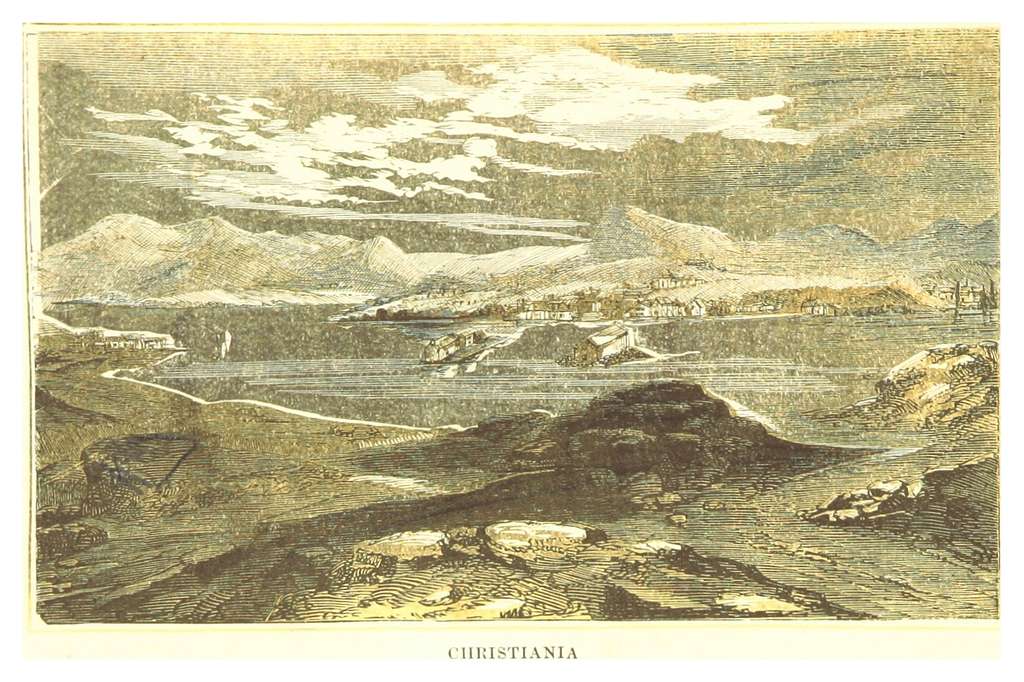
Pfeiffer, Christiana (Oslo) 1853
English has been raiding Scandinavia’s vocabulary for over a thousand years, starting with the Vikings and never really stopping. Words like sky, knife, window, and skill came in during the Viking Age via Old Norse and are now so thoroughly English that nobody thinks twice about them. But the more recent, more traceable borrowings—the ones from modern Norwegian, Swedish, Danish, Finnish, Icelandic, and Greenlandic—tell a much funnier and more specific story, one involving fjords, hot springs, hooded jackets, and a truly unfortunate Swedish training term.
Norway gave English its landscape vocabulary almost wholesale. Fjord is the obvious one: Merriam-Webster traces it to Norwegian fjord, from Old Norse fjǫrthr, and the word’s first recorded English use was in 1674. It’s a rare specimen too — fjord is one of only two English words that begin with the letter combination “fj,” the other being fjeld. Ski, slalom, troll, and lemming followed the same route, riding into English on the back of 19th-century polar exploration and, later, winter sports.
Sweden is responsible for the word you use every time you approach a hotel buffet with unreasonable ambition. No, it’s not IKEA. Smorgasbord was borrowed from Swedish smörgåsbord, itself built from smörgås (“open sandwich,” literally “butter-goose”) plus bord (“table”) — so etymologically, you are eating at a “butter-goose table.” Ombudsman comes from Swedish ombud (“delegate” or “representative”) plus man, and moped is a Swedish abbreviation for “motor” plus “pedaler” that was coined in a Swedish magazine in the 1950s. Then there’s the funniest one: fartlek, a real and very serious running-training method, means “speed play” in Swedish — a name that lands rather differently on English ears than it does on Swedish ones.
Denmark contributed hygge, a word for cozy, convivial contentment that is thought to derive from a Danish term meaning “to instill courage, give comfort, joy,” and which became a global lifestyle buzzword in the 21st century despite being notoriously hard to translate. Danish is also where you get lur (a nap) — less famous, but increasingly borrowed by cozy-lifestyle bloggers.
Finland’s single great export to English is sauna, and its history is oddly divided: linguists trace the word itself to Proto-Finnic *sakna, possibly borrowed from early Proto-Germanic *stakna-, while its English debut came in 1881. Finnish also gave the world sisu, a term for grit or stubborn resilience that Finns invoke constantly and everyone else has started stealing for self-help books.
Iceland handed English one of its more dramatic borrowings almost by accident. Geysir was simply the proper name of a single hot spring in the Haukadalur valley — literally “the gusher,” from the Old Norse verb geysa, “to gush” — but visiting English speakers, not quite understanding it was a specific spring’s name, generalized it into the common noun “geyser” for any spouting hot spring. Iceland effectively lost a proper noun to the rest of the world.
Greenland — via Kalaallisut, the Greenlandic Inuit language — gave English two wardrobe staples. Anorak comes from Greenlandic annoraaq, brought back by 19th-century whalers, and picked up a second, less flattering British slang meaning: a person with an obsessive, often trainspotter-grade interest in a niche topic (the joke being that trainspotters actually wore anoraks while spotting trains). Kayak traces to the Inuit word qajaq, meaning “man’s boat” or “hunter’s boat”, a term shared across Inuit and Yupik dialects from Greenland westward.
Here’s the rundown:
| Language | Word | Original meaning | Meaning in English | Fun fact |
|---|---|---|---|---|
| Norwegian | fjord | inlet, estuary | a long, narrow sea inlet | One of only two English words starting with “fj” |
| Norwegian | troll | (folklore creature) | ugly mythical creature / internet pest | Same word, wildly different battlefield |
| Norwegian | ski | (a strip of wood) | snow-gliding equipment/sport | Norway also gave us slalom |
| Swedish | smorgasbord | sandwich-table (lit. “butter-goose table”) | lavish buffet | You’re technically dining at a goose table |
| Swedish | ombudsman | delegate + man | official complaints representative | Some Swedish speakers now say ombudskvinna |
| Swedish | fartlek | speed play | a running-training technique | Purely coincidental hilarity for English speakers |
| Danish | hygge | to instill comfort/courage | cozy contentment | Became a whole marketing genre in the 2010s |
| Finnish | sauna | steam bath | Finnish steam bath, now any hot box | Entered English dictionaries in the 1880s |
| Finnish | sisu | (inner) grit, guts | stubborn resilience | Finland’s unofficial national personality trait |
| Icelandic | geyser | “the gusher” (a specific spring’s name) | any spouting hot spring | Started as one hot spring’s actual name |
| Greenlandic | anorak | hooded outer garment | hooded jacket / obsessive hobbyist (UK slang) | Second meaning comes from trainspotters |
| Greenlandic | kayak | hunter’s boat | small paddle-powered boat | Shared root across Inuit-Yupik languages |
The pattern across all six is basically the same: English borrows the word for the thing it doesn’t have a word for — a specific landscape feature, a specific bathing ritual, a specific garment — and then, with characteristic disregard for the original, promptly bends the meaning into something the borrowers never intended (see: “anorak” the nerd, or “geyser” the common noun that used to be someone’s hot spring’s actual name).


 English