
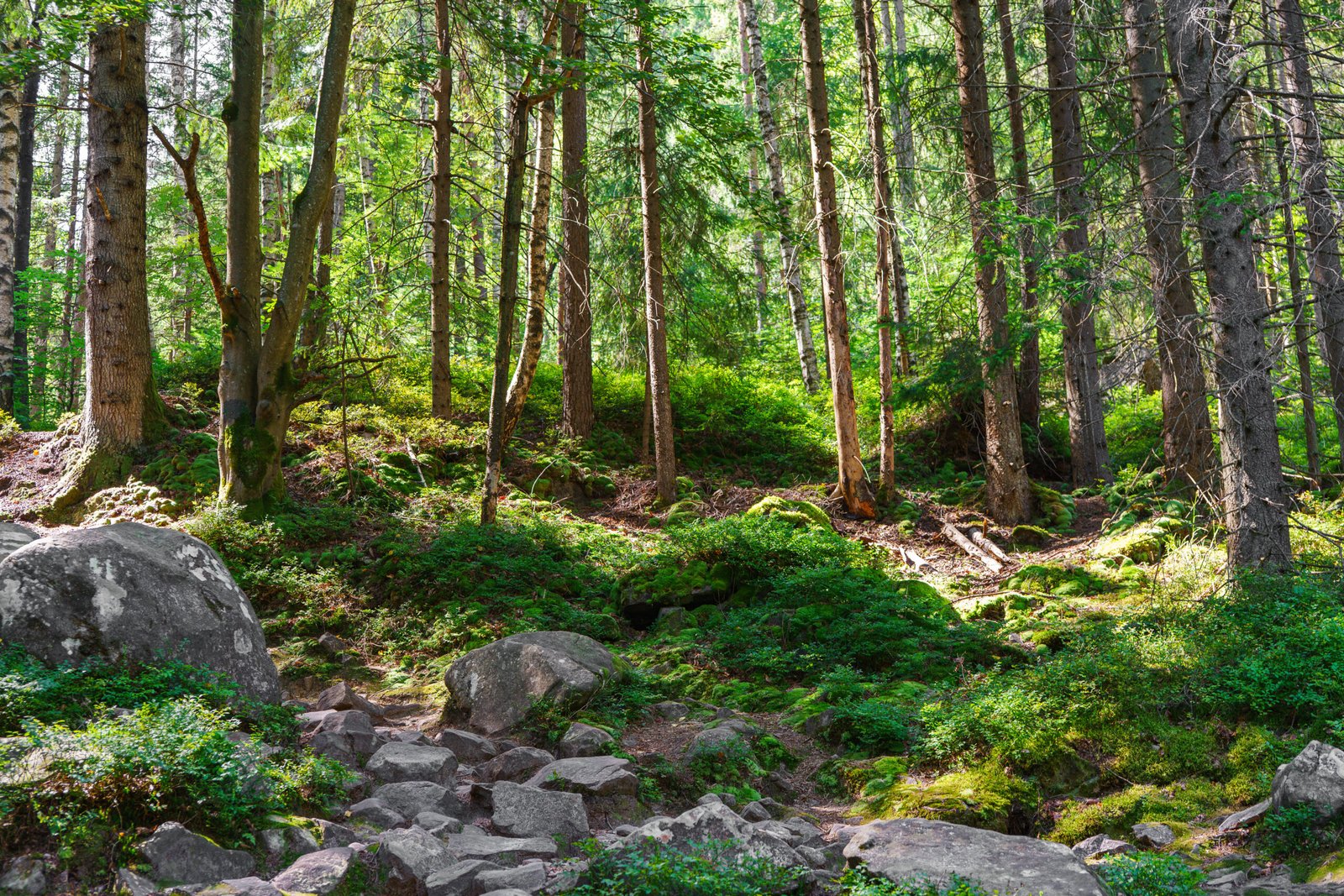
If you have been to Scandinavia and walked through a forest, you’ll probably understand. There’s a moment, walking deep enough into a Norwegian spruce forest, when the light changes and the trees feel less like scenery and more like presences. Scandinavians have been naming that feeling for over a thousand years. Long before ecology existed as a discipline, Norse and Nordic folklore built an elaborate architecture of rules, spirits, and warnings around the forest — and a surprising amount of it turns out to have been, quietly, correct.
Yggdrasil and the Idea of a Connected Forest
The foundational image in Norse cosmology is a tree. Yggdrasil, the world ash, holds together all nine realms with its roots and branches, and the health of the cosmos is directly tied to the health of the tree — when it shakes, Ragnarök is coming. It’s a creation myth in which destruction is unthinkable without first destroying a forest.
What’s easy to miss is how biologically specific this is. The tree is described as an ash, Fraxinus excelsior, and the first humans, Ask and Embla, are made from ash and elm. This matters in 2026 more than it might seem: both ash and elm are now critically endangered across northern Europe, devastated by Hymenoscyphus fraxineus (ash dieback) and Dutch elm disease respectively. Swedish-British ecologist Andreas Kornevall has drawn this parallel explicitly — that the trees from which humanity was supposedly made are dying, and we’re barely paying attention.
Yggdrasil also contains a functioning ecosystem, described in some detail in the Prose Edda. An eagle sits at the crown. A dragon, Níðhöggr, gnaws at the roots. A squirrel called Ratatoskr runs between them carrying messages, or, if you’re uncharitable, gossip. Four stags graze the branches. The three Norns tend the tree’s roots and water it from the Well of Urðr. The image is not of a lone sacred object. It’s of a system — predators, decomposers, grazers, caretakers — all bound to the same structure. Strip one element out and the whole thing wobbles.
Ecologists call this trophic interdependence. The Norse had a myth for it.
The Skogsrå: Don’t Disrespect the Forest
If Yggdrasil is the philosophy, the Skogsrå — forest spirit, also called Huldra in Norwegian tradition — is the enforcement mechanism.
She appears as a beautiful woman at the forest’s edge. From the front, entirely human. From behind: hollow, like a rotted tree trunk, or sometimes with a cow’s tail. She governs the forest and everything in it. Hunters who treated her with respect — who didn’t boast, didn’t waste kills, who asked permission — she helped find game. Those who didn’t were led in circles, lost in the woods overnight, or worse.
The word skogsrå comes from Old Swedish rå, which means something like “ruler” or “guardian.” She’s not simply a forest ghost. She’s a landlord, and her tenancy agreements were clear: take only what you need; don’t abuse what the forest gives you. Hunters in Sweden and Norway observed specific protocols when entering the forest — speaking respectfully, not overhunting, acknowledging the spirit’s domain. These weren’t superstitions so much as behavioural codes, packaged into story because story is what sticks.
The Swedish version of the Skogsrå is notably harder than the Norwegian Huldra. Where Norwegian folklore often portrays Huldra as benign toward charcoal burners and helpful to men who treated her well, Swedish tradition described her as more consistently dangerous, associated specifically with the dense primeval forest rather than the summer pasture. The geography of the story tracks the ecology: Norwegian folklore developed in a more pastoral, mixed landscape; Swedish tales come from deeper, older woodland.
Whether the Skogsrå was ever “real” in the folkloric sense matters less than what she required of people. Her rules, passed down orally for generations, functioned as a distributed conservation ethic.
Sacred Trees and the Vörðr
It wasn’t just spirits roaming the forest. Individual trees were themselves sacred. The Norse concept of the vörðr (guardian) extended to particular trees planted near homesteads, called guardian trees or vård-träd. Spirits were believed to live under their roots. Harming the tree brought misfortune on the household. Cutting it down was essentially burning your home’s foundations.
The ash was the most revered of all Nordic trees — world tree, ancestor tree, medicinal tree. Offending an ash, the Fiskars Museum’s documentation of Nordic tree mythology notes, caused illness. Urinating on its roots was a specific prohibition. The rowan (Thor’s tree) was used for protective charms, its wood prescribed for rune-carving and divination. Specific trees were forbidden to cut at certain times. Specific uses required specific permissions, sometimes ritual ones.
This looks, from a distance, like animism. It is animism. But animism with this level of species-specific detail also functions as accumulated ecological knowledge — knowledge about which trees were rare, which were structurally vital, which supported the most life.
Sacred Groves: Protected Land by Another Name
Beyond individual trees, the Norse maintained sacred groves — forested clearings where rituals took place, offerings were made, and the regular rules of resource extraction did not apply. Roman accounts from the first century CE describe Germanic peoples conducting ceremonies in forest clearings; Scandinavian archaeology and place-names preserve traces of these spaces throughout the region.
The groves were, functionally, no-take zones. Not managed for timber, not hunted intensively, not cleared for agriculture. Whether their protection was understood in spiritual or practical terms probably depended on who you asked. The result was the same: patches of older, undisturbed forest embedded in an otherwise worked landscape.
Modern ecology has a term for this too. Refugia — pockets of undisturbed habitat that allow species to persist and recolonize surrounding areas after disturbance. That’s not a coincidence exactly; it’s more that the practice and the function were always aligned, and the spiritual framing made the practice durable across generations.
What the Forest Actually Looked Like
It’s worth being precise about the landscape these myths emerged from. Scandinavia’s forests are boreal — spruce, pine, birch, with a long history of fire, grazing, and human modification. The forests that pre-Christian Norse people lived among were structurally complex: varied in age, full of dead wood, subject to natural disturbance cycles including wildfire that created a patchwork of habitats.
Since the mid-20th century, intensive clearcutting has dramatically homogenized that landscape. A 2025 study published in Biological Conservation found that old-growth forests in boreal Europe harbour species assemblages distinct from both managed forests and clearcut sites, with conservation of these rare remnants considered essential for maintaining biodiversity. Sweden’s own forest agency assessments have found that 14 of 15 forest habitat types listed under the EU Habitats Directive do not have a favourable conservation status. Some 1,400 species are on the Swedish Red List as a direct consequence of forestry practices.
The forest the Skogsrå was guarding no longer exists across most of Scandinavia. What’s left is mostly plantations, or young second-growth, or the small fraction of high-conservation-value forests that researchers and environmental groups are currently fighting to protect — including organisations like Skydda Skogen (Protect the Forest), which has been documenting unprotected high-value forest sites across Sweden.
The Limits of the Analogy
It would be convenient to argue that pre-Christian Norse people were proto-ecologists who got everything right. They weren’t. The same culture that observed careful protocols around sacred trees also cleared land aggressively for agriculture, grazed livestock in forests until they degraded, and contributed to the extinction of local megafauna. Sacred groves protected certain patches; they didn’t prevent deforestation more broadly.
And the Ásatrú revival — the modern religious movement drawing on Old Norse spirituality, currently the fastest-growing religion in Iceland — doesn’t come without complications. Scholars and practitioners have spent considerable effort disentangling ecological and community-oriented interpretations from the white nationalist currents that also, unfortunately, find Old Norse imagery appealing. The mythology itself is neutral on this; how it’s deployed is not.
What Norse folklore does offer is something more modest but still useful: a long tradition of encoding behavioural norms in narrative, of making the forest feel inhabited and therefore governed, of distributing ethical responsibility for an ecosystem across an entire community through shared story.
The Hollow Back
The Skogsrå’s hollow back — that detail that keeps appearing in the Swedish tradition — is easy to read as a simple horror-story touch. Look closer and it reads like something else: a woman who appears solid from the front but is revealed, from behind, to be made of rotting wood. Not a monster. A forest in the shape of a person. The hollowness isn’t a flaw; it’s what she is.
What the old stories understood, and what Yggdrasil’s trembling was always about, is that forests are not backdrops. They are structures that other things depend on. You don’t see that from the front. You have to go around.
Further reading:
- Prose Edda, Snorri Sturluson (13th century; multiple modern translations available)
- Tommy Kuusela, “Spirited Away by the Female Forest Spirit in Swedish Folk Belief”, Folklore Vol. 131 No. 2, 2020
- Andreas Kornevall’s work on ecological Norse revival via Earth Restoration Service
- Skydda Skogen — ongoing documentation of Sweden’s high-conservation-value forests
- Berglund & Kuuluvainen, “Representative boreal forest habitats in northern Europe”, Ambio, 2021







 English