
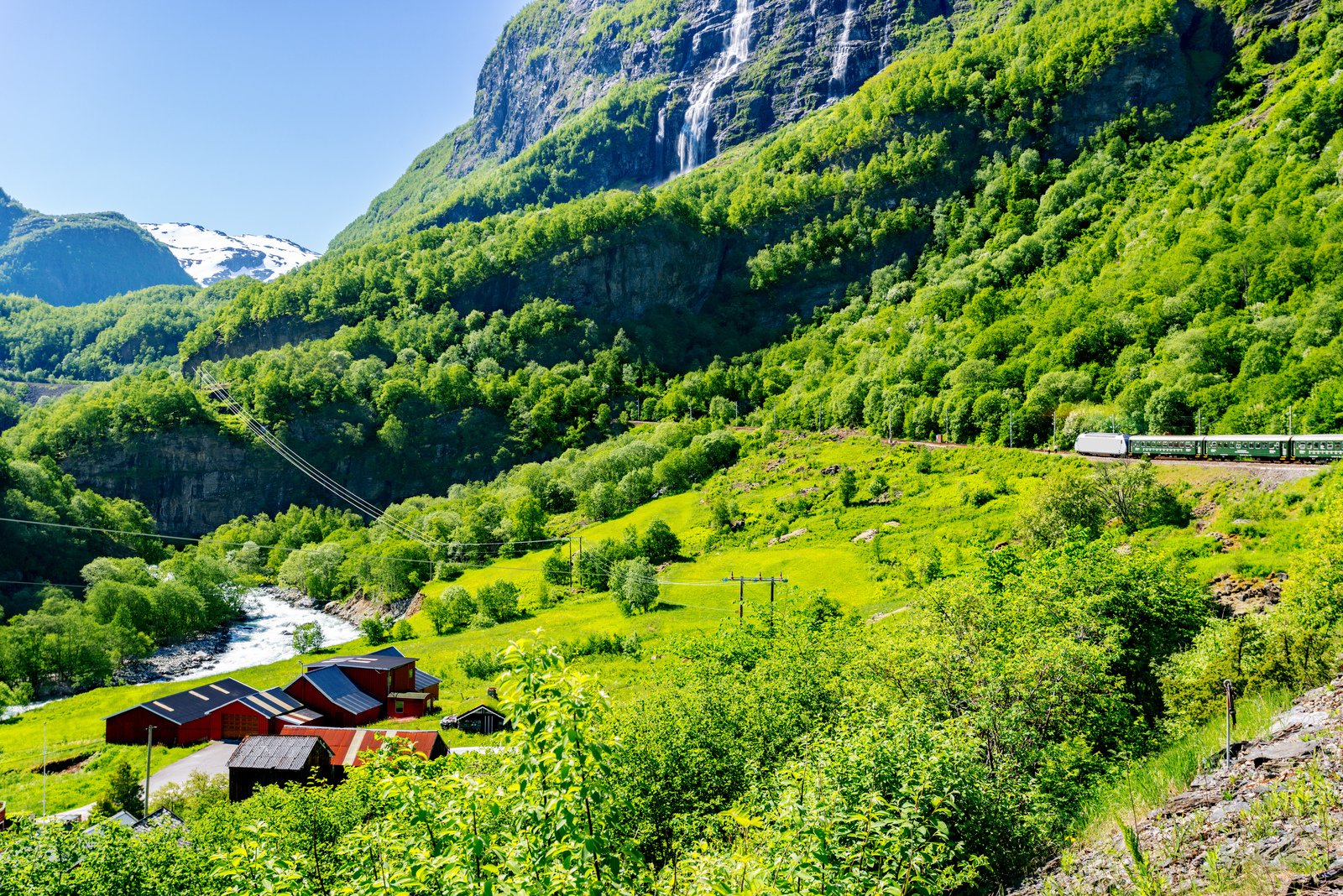
The Flåm Railway gets called the world’s best train journey often enough that the claim has started to feel like marketing copy. It isn’t, quite. Lonely Planet has ranked it among the best in the world, and National Geographic Traveler put it on their list of Europe’s ten best rail journeys. What those lists don’t tell you is how to actually book the thing, which direction to sit, or what happens if you miss your connection at a mountain station with no road in or out. That’s the part worth sorting out before you go.
What it actually is
The Flåmsbana runs 20 kilometers between Myrdal, a station high on the Bergen Line at 867 meters above sea level, and Flåm, a village at the head of the Aurlandsfjord that sits at essentially sea level. The descent averages a 5.5 percent gradient, which makes it one of the steepest standard-gauge railways anywhere. Construction started in 1923 and took seventeen years, mostly because eighteen of its twenty tunnels had to be dug by hand. The line runs year-round, and the whole one-way trip takes about 55 minutes to an hour.
There’s no first or second class. Every seat is the same, and the vintage-style green carriages with red seats are part of the appeal rather than an upgrade you pay for.
The one stop everyone photographs
About halfway down, the train stops for roughly five minutes at Kjosfossen, a 225-meter waterfall that the line was built to run directly alongside. You’re allowed off the train onto a small platform right at the base of the falls, and in summer, dancers dressed as a huldra, a mythical forest spirit from Norwegian folklore, appear briefly near the water before the whistle blows and everyone piles back on. It’s a bit theatrical, and it works anyway, mostly because the waterfall itself is genuinely enormous at that range.
Which direction, and which side to sit
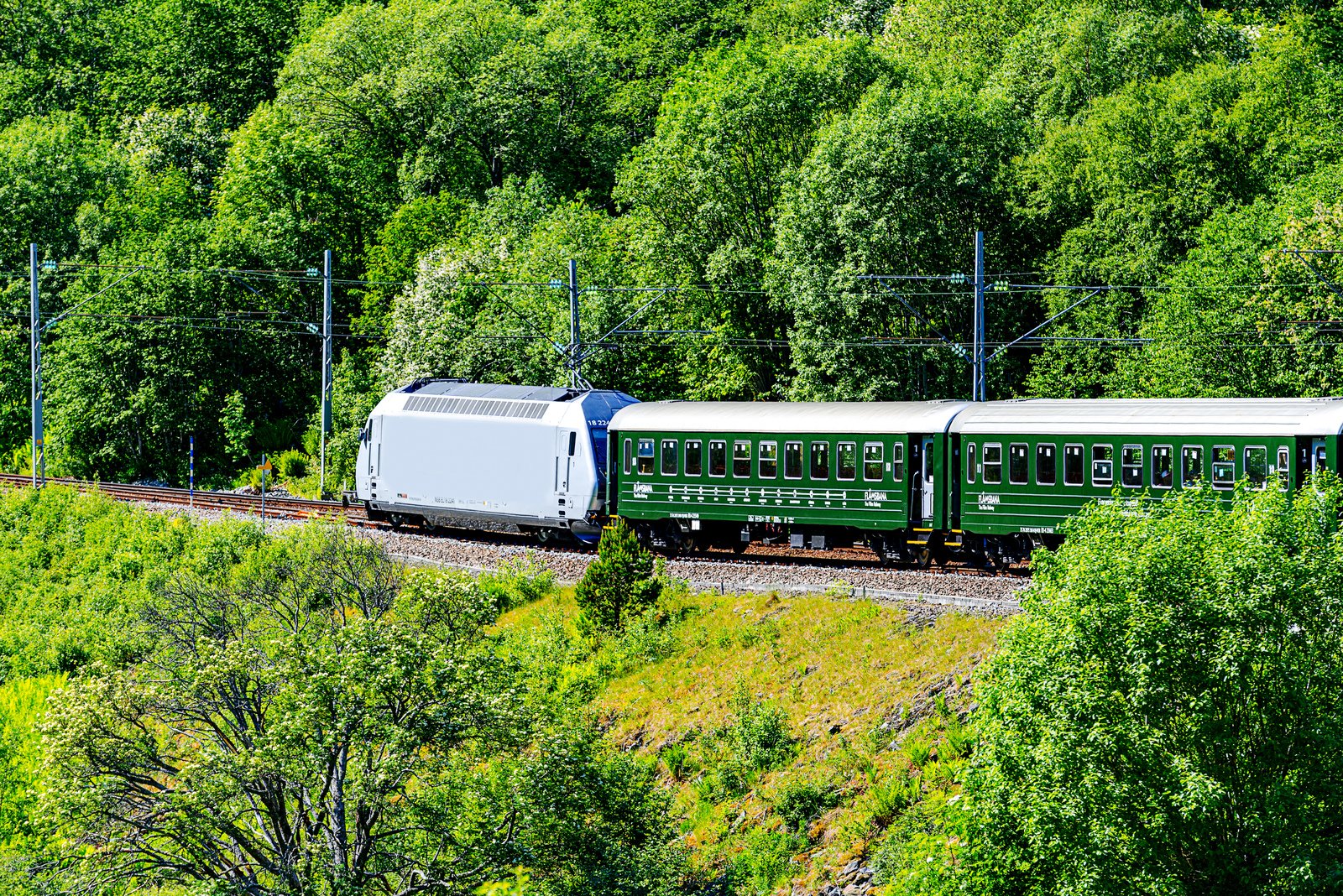
This is the question people actually argue about, and the honest answer is that the Flåm Railway itself looks the same both ways. Direction only matters for the larger day you’re building around it.
If you’re doing a straight there-and-back from Flåm, the Flåmsbana route’s own FAQ recommends taking the first connecting departure from the Bergen Line when you arrive, and the first return train back if you’re doing Flåm–Myrdal–Flåm in one go, since Myrdal has little more than a waiting room and a seasonal café if your connection runs long.
If you’re combining the railway with the wider Nutshell route (more on that below), the seasoned opinion, echoed across enough independent trip reports to trust, is that the inner loop should run counterclockwise: Myrdal, then Flåm, then Gudvangen, then Voss. You’re travelling downhill through the dramatic part first, from mountain plateau into fjord, which most people find visually stronger than doing it in reverse.
As for the outer question, whether to travel Oslo to Bergen or Bergen to Oslo, opinions split for a good reason. Doing it Bergen-first puts the fjord and railway sections earlier in your day, leaving the long, flatter stretch to Oslo for whenever you’re ready to nap. Doing it Oslo-first means a longer haul before you reach the interesting part, and if you’re travelling in a season with limited daylight, you risk hitting Kjosfossen and the Aurlandsfjord in the dark. One Bergen-based guide put it plainly: seeing the nicest scenery in daylight is worth structuring the whole day around, which argues for starting in Bergen if you have a choice and are travelling outside peak summer daylight.
On seating: sit right, travelling Flåm to Myrdal, for the best sightline to Kjosfossen and the valley, and left for fjord views on the way down from Myrdal to Flåm. If you’re continuing onward on the Bergen Line itself afterward, seat-side advice flips again roughly halfway through that longer leg, so don’t get too attached to one side of the train for the whole day.
Booking it: on its own, or as Norway in a Nutshell
You’ve got two ways to do this, and they cost noticeably different amounts.
The packaged version, sold as Norway in a Nutshell by Fjord Tours, bundles the Bergen Line, the Flåm Railway, a fjord cruise through the Nærøyfjord and Aurlandsfjord, and a connecting bus through Voss and Gudvangen into one ticket. It’s simple, and it removes the risk of a tight connection derailing your day. It also costs more than booking the same legs separately, sometimes by close to half.
The independent version means booking each leg yourself: the Bergen Line ticket through vy.no, the Flåm Railway ticket through en.flamsbana.no or norwaysbest.com, and the fjord cruise separately as well. The saving is real if you book roughly 60 to 90 days ahead, since Norwegian rail fares climb steadily the closer you get to departure. The tradeoff is that you’re managing your own connections, and a delay on one leg is your problem to solve, not the tour operator’s.
A practical note that trips people up: if you’re holding a Eurail or Interrail pass, it gets you a 30 percent discount on the Flåmsbana fare, but the discount ticket has to be bought at a staffed station, through Entur, or by phone. It isn’t available through the regular online booking flow.
Connections at Myrdal: what to actually expect
Myrdal is not a town. It’s a mountain junction with a platform, a waiting room, and, in summer only, a small café. There’s no road to it at all, which is part of what makes the setting dramatic and also exactly why you don’t want to be stuck there for three hours with a dead phone battery.
The good news is that connection times listed as short (sometimes ten or fifteen minutes) are generally fine, because the Flåm Railway and the Bergen Line coordinate their schedules specifically for this transfer, and there’s essentially no walking involved. One detailed independent guide notes that these short-looking transfer windows are intentional and that each leg is timed to wait for the connecting one if there’s a minor delay, so don’t panic at a tight-looking timetable. Do still hustle rather than lingering over a coffee, though, since the reverse isn’t guaranteed and station facilities at Myrdal genuinely thin out outside peak season.
Connections with Oslo and Bergen specifically
From Oslo, you’re riding the full Bergen Line to Myrdal first, a journey of around five hours across the Hardangervidda plateau, Northern Europe’s highest and largest mountain plateau, before transferring down to Flåm. Same story in reverse coming back.
From Bergen, the Bergen Line ride to Myrdal is considerably shorter, since the fjord country sits much closer to Bergen than to Oslo. This is the main practical reason experienced guides tend to recommend structuring a round trip out of Bergen rather than Oslo if you don’t have time to do the whole Oslo–Bergen crossing: you reach the interesting scenery faster and you’re not committing to a full transcontinental rail day just to see one waterfall and one fjord.
Either way, book the Bergen Line and Flåm Railway as separate tickets when searching independently. Booking platforms won’t recognize “Oslo to Flåm” as a single through-search; you generally need to book Oslo–Myrdal and Myrdal–Flåm (or the Nutshell package, which handles this for you) as distinct legs.
Practical odds and ends worth knowing before you go
- No dining car on the Flåmsbana itself. Café Rallaren at Myrdal operates seasonally; Flåm station has proper food options. Pack something for the ride if you’re doing this outside summer.
- Luggage: self-service lockers are available right outside the Flåm visitor center, useful if you want to do a there-and-back without hauling bags.
- Bikes need a reserved space booked at the same time as your ticket, and some Bergen Line departures carry very few bike slots.
- Wheelchair access is available with 48 hours’ notice, though the Kjosfossen stop itself isn’t accessible, and the waterfall isn’t visible from the carriage with the wheelchair space.
- Weather: this is one of the rainiest corners of Norway. Layer up and bring a proper rain shell regardless of season; several independent trip reports mention rain on more than nine trips out of ten in summer specifically.
- Book early if you’re travelling in summer. Flåmsbana tickets for the coming summer season are usually released in January, and popular July and August departures sell out weeks ahead.
A last word on expectations
The hype is mostly earned, but it’s worth knowing what you’re actually getting: a one-hour train ride, not a day-long expedition. The waterfall stop is genuinely striking and the valley views are real, but this line rewards people who’ve built a fuller day around it, whether that’s the full Nutshell loop or simply a night in Flåm itself, rather than people expecting an hour on a train to define their whole trip to Norway.
Sources and further reading
- The Flåm Railway official site — Flåmsbana AS
- Flåm Railway FAQ — Flåmsbana AS
- Stations and stops on the Flåm Railway — Flåmsbana AS
- The Flåm Railway overview — Vy
- Flåm Railway: A Practical Guide — Norwegian Routes
- Flåm Railway Guide: Tickets, Timings, Route, Best View Seats — Pick Your Trail
- Norway in a Nutshell on Your Own — Fjords and Beaches
- Norway in a Nutshell Review: Is It Worth It? — Helen on her Holidays
- How to Do Norway in a Nutshell on Your Own — Earth Trekkers
- Norway in a Nutshell, on your own — Travel Cheat Sheet



 English