
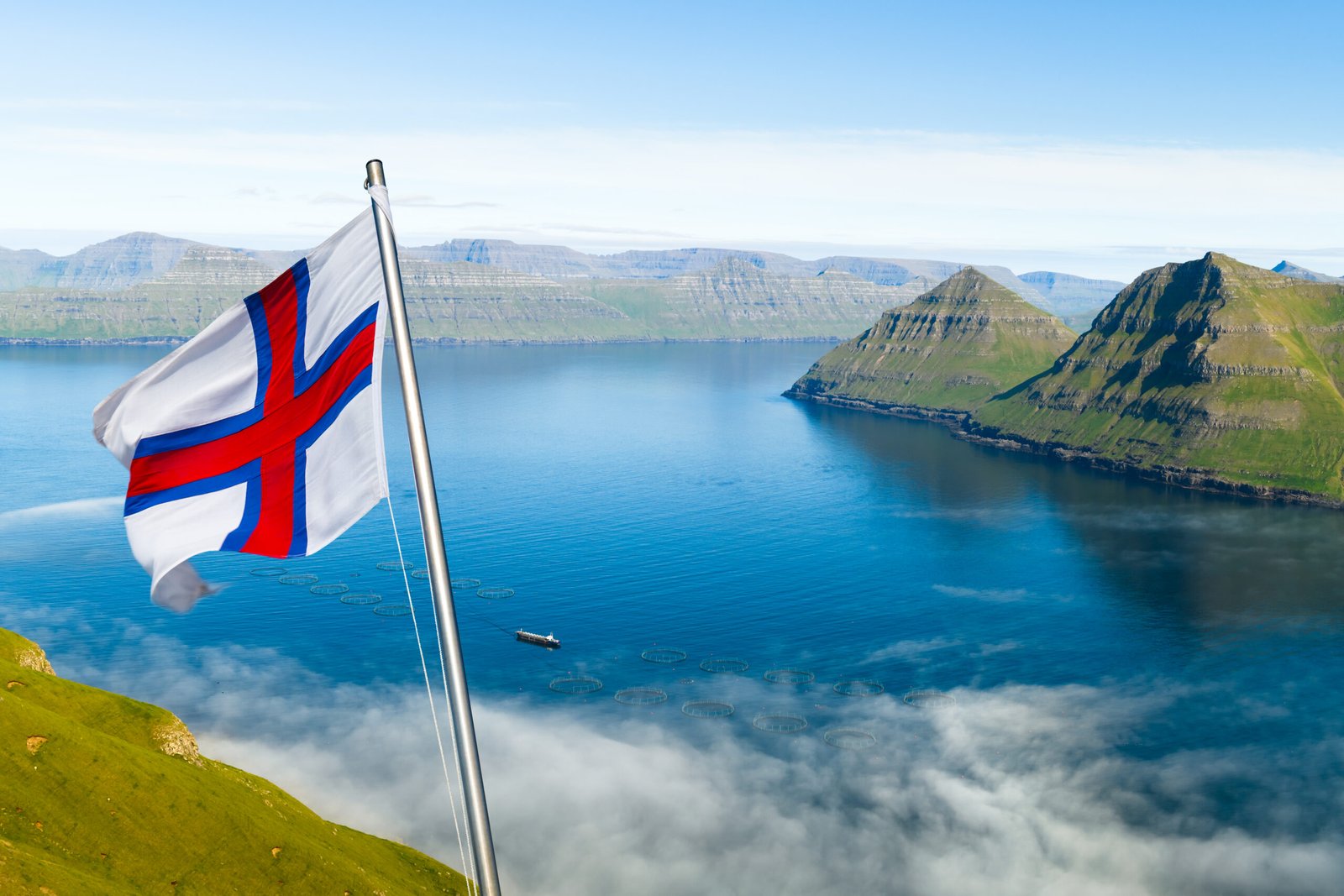
18 islands, 55,000 people, one of the most complicated relationships with nationhood in Europe — and the airport landings are genuinely terrifying.
There is a particular kind of place that resists easy description. The Faroe Islands is one of them. Technically part of the Kingdom of Denmark, but not Denmark. Not in the EU, even though Denmark is. Home to a parliament older than almost any in the world, yet still technically a dependent territory. Somewhere between Iceland and Scotland geographically, and somewhere between an independent nation and an autonomous region politically — though which side of that line it currently sits on depends very much on who you ask.
What follows is a thorough look at the Faroe Islands: its history, its people, its language, its most contentious traditions, and the increasingly serious conversation about whether it will one day stand alone.
The Basics: Where Are the Faroe Islands?
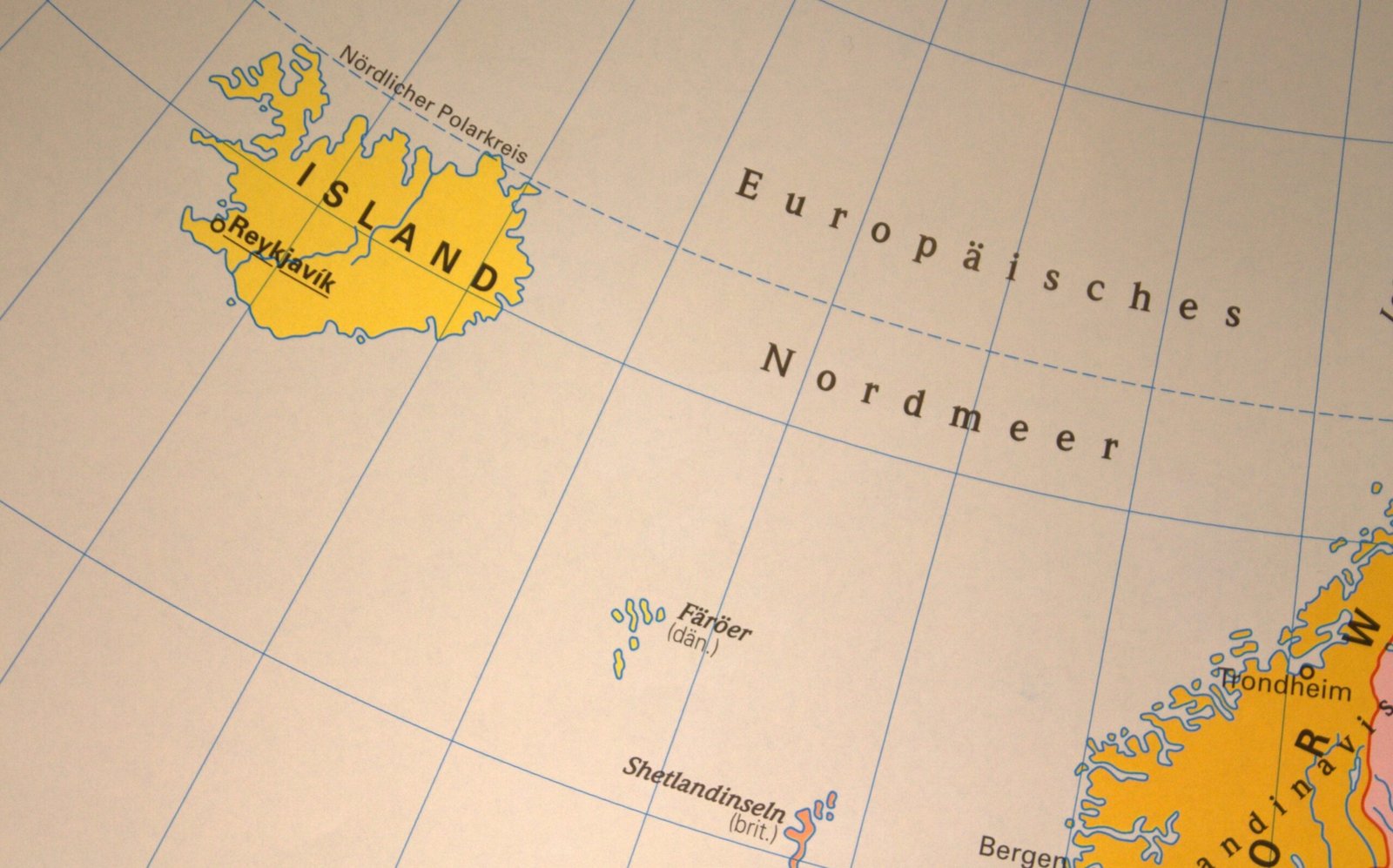
The Faroe Islands sit in the North Atlantic Ocean roughly halfway between Norway and Iceland, about 320 kilometres (200 miles) north-northwest of Scotland. The archipelago comprises 18 islands — 17 of which are inhabited — covering a total land area of about 1,400 square kilometres (540 square miles). The population currently stands at around 55,000, making it one of the smallest self-governing territories in the world.
The capital, Tórshavn, is home to roughly a quarter of the population. It is also, by some counts, the world’s smallest capital city — which has not stopped it from having a full legislative parliament, several universities, a national football league, and a surprisingly decent music scene.
The landscape is treeless, mountainous, and cut through by fjords. The weather is what you’d expect from something positioned in the North Atlantic: wet, windy, frequently grey, and capable of producing four seasons before noon. Annual precipitation averages around 1,600mm. The climate is technically oceanic — mild enough that snow is rare at sea level, but “mild” is doing a lot of work in that sentence when the wind gets involved.
History: From Monks to Vikings to Danish Rule
The First Settlers
The earliest inhabitants of the Faroe Islands were likely Irish monks — the papar, as they were known — who arrived around the 6th century AD seeking isolation for contemplation. They found it. They also left relatively little trace beyond a few place names and the knowledge that someone was there before the Norse arrived.
The Vikings came around 800 CE, settling the islands and establishing a society built on Old Norse traditions. By around 900, the Faroese had formed their own parliamentary assembly — the Ting — making it one of the oldest parliaments in existence. The landscape of power was already distinctly Faroese from very early on.
Norwegian and Danish Rule
Around 1035, the Faroe Islands came under Norwegian sovereignty. That arrangement held until 1380, when Norway and Denmark entered a union through a royal marriage. In 1397, the Kalmar Union brought Denmark, Norway, and Sweden under a single crown, and the Faroes went with Norway into that arrangement.
Things got more complicated in 1814. The Treaty of Kiel dissolved the Danish-Norwegian union, with Norway passing to Sweden. The Faroe Islands, however, stayed with Denmark — a decision made in Copenhagen, not Tórshavn. From 1816, the islands were redesignated as a Danish county (amt), and their ancient parliament, the Løgting, was abolished. It was partially reconstituted as an advisory assembly in 1852, but real self-governance was gone.
The 17th and 18th centuries had also brought the Faroe trade under tight Danish control. In 1709, it became a royal monopoly, with Copenhagen controlling what the islands could buy and sell. That monopoly was lifted in 1856, which opened the door for a native middle class to develop — and with it, a new sense of national identity.
The Language Crisis and the Rise of Faroese Nationalism
The 19th century was when Faroese national consciousness crystallised. At the time, Danish had effectively replaced Faroese as the written and official language of the islands — the Church, administration, and schools all operated in Danish. Faroese survived only as a spoken language, preserved through oral tradition, poetry, and the chain dances (Faroese: serkansøng) that passed ballads from generation to generation.
In 1846, the linguist V.U. Hammershaimb created a standardised written form of Faroese, giving the language a foundation it had lacked for centuries. This happened when fewer than 8,000 people lived on the islands. The fact that the ballads had survived this long entirely through oral transmission — without being written down — is something Faroese historians describe as remarkable. One scholar quoted in the Guide to Faroe Islands calls it, without much exaggeration, “a miracle.”
Faroese became an official language in 1938. It is now the primary language of daily life, and its preservation is a high political priority.
World War II and the Road to Home Rule
During World War II, the British occupied the Faroe Islands to prevent German control, but — crucially — they left Faroese internal affairs alone. That experience of genuine self-government, combined with Iceland declaring itself a republic in 1944, shifted something in the Faroese political imagination.
In September 1946, the Faroe Islands held a referendum on independence. The result was extremely close: 50.7% in favour of leaving Denmark. The Speaker of the Løgting declared independence on 18 September 1946. Denmark did not accept the result. King Christian X dissolved the parliament and called new elections, which were won by unionist parties. What followed was two years of negotiations that produced the Home Rule Act of 1948 — the Faroe Islands would remain within the Kingdom of Denmark but gain extensive domestic authority over language, economy, social policy, and fishing waters.
It was not independence. But it was, as one analysis from peterschulte.org notes, “genuine political recognition — and a durable framework that has only deepened over the decades since.”
In 2005, a further autonomy agreement expanded Faroese self-governing powers, and the islands now control most domestic policy, maintain their own trade agreements, and even field their own national sports teams.
The Faroese Language: A Survival Story
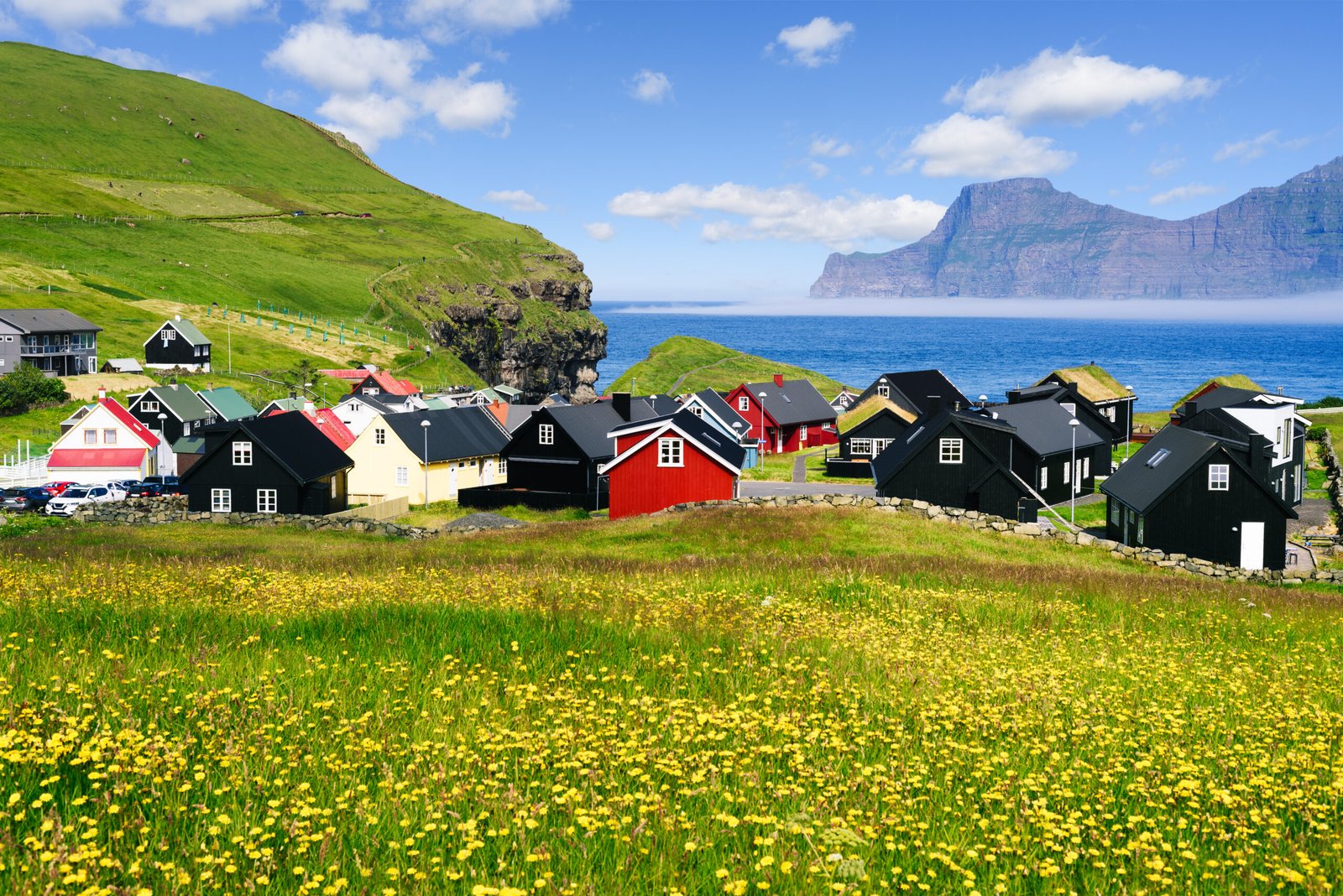
Tjornuvik village, stacks Risin and Kellingin, Eysturoy, Faroe Islands,
Faroese is a North Germanic language descended from Old Norse. It is most closely related to Icelandic, and shares characteristics with the western dialects of Norwegian. What makes it unusual in the European context is how thoroughly it diverged from Danish during the 17th and 18th centuries while being surrounded by Danish institutional dominance.
The oldest known Faroese text — Seyðabrævið (The Sheep Letter) — dates to around 1310. By about 1400, Faroese was showing distinct characteristics of its own independent language. Then came the Reformation, and with it, centuries during which Faroese disappeared almost entirely as a written form, kept alive only in ballads and conversation.
Today, roughly 55,000 people in the Faroe Islands speak it, plus an estimated 25,000 in Denmark and 5,000 in Iceland. That is a total speaker population of around 80,000 — comparable to a mid-sized city. The Faroese government funds active research into the language’s development and takes its preservation seriously at a policy level. New technology terms are coined in Faroese rather than borrowed from English: the Faroese word for “computer” is telda. The language is kept alive not out of nostalgia but out of something that reads more like national stubbornness.
Danish remains an official language alongside Faroese and is widely understood, particularly in education and government. But walk into a café in Tórshavn and you will hear Faroese.
The People: Who Are the Faroese?
The Faroese are an ethnic group of mixed Norse and Gaelic origin. They are the descendants of the Viking settlers who arrived around 800 CE, with genetic evidence suggesting significant contributions from Scotland and Ireland alongside the Norwegian Norse — likely reflecting the slaves and settlers the Vikings brought with them from those regions.
The total Faroese diaspora is estimated at around 70,000 people, with roughly 50,000 on the islands themselves and the remainder primarily in Denmark. The population has grown dramatically from 5,265 in 1801 to over 55,000 today.
The Faroese are, by most accounts, Lutheran. The Church of the Faroe Islands (which became formally independent from the Danish Lutheran Church in 2007) is the state church. Religion in the Faroe Islands is taken seriously but not ostentatiously — the islands have a quiet piety that reflects their isolation and their relationship with an environment that regularly reminds you it can kill you.
Culturally, the Faroese are fiercely proud and somewhat private. They are not given to self-promotion. The islands have produced internationally noted artists, musicians, and writers, but you would not know it from the way Faroese people generally talk about themselves. The national character, if one can generalise, tends toward understatement.
Arriving in the Faroe Islands: The Airport Experience
There is one airport. It is Vágar Airport (IATA: FAE) on the island of Vágar, connected to the main island of Streymoy via an undersea tunnel. The flight from Copenhagen takes about two hours. What happens in the last few minutes of that flight is what people tend to remember.
Vágar Airport sits on low-lying land beside the sea, surrounded by mountains and fjords. The approach to the runway runs close to high terrain where wind conditions can shift dramatically with little warning. A meteorological phenomenon called orographic lift — moist air pushed upward by the island’s mountains — generates turbulence and sudden wind shifts during the landing phase. Pilots flying to Vágar are required to complete special training for the airport’s unique topography and weather patterns, according to Vaisala, the weather technology company that supplies the airport’s visibility systems.
The North Atlantic delivers what it delivers. Crosswinds gusting to 30 or 40 knots are not unusual. The runway visual range can drop quickly. Fog rolls in from the ocean with almost no warning. The airport’s air traffic controllers continuously monitor conditions and adjust schedules in real time — meaning that your flight can be diverted to Iceland or cancelled after you have already boarded.
Loveexploring.com, which tracks the world’s most challenging airport approaches, includes Vágar among the hardest landings on the planet: “pilots bringing down their planes at Vagar Airport often have to confront the incredibly forceful and unpredictable winds that the territory is famous for.” That is politely put. Passengers who have landed there in strong conditions tend to describe it more vividly.
If you do make it down, the view from the cockpit window on approach — fjords and cliffs and dark sea — is, by nearly universal agreement, extraordinary.
Culture: Chain Dancing, Ballads, and the Whale Hunt
Faroese Cultural Identity
Faroese culture has historically been shaped by isolation, a subsistence economy, and an intense relationship with the sea. Traditional Faroese society was built around sheep farming and inshore fishing, both of which left deep marks on the culture. The sheep are still everywhere — the Faroese word Føroyar literally means “Sheep Islands” — and fishing remains the foundation of the economy.
The cultural tradition that outsiders encounter most often is the Faroese chain dance (Faroese: føroyskt dansur), a form of round dancing accompanied by the singing of ballads — many of them medieval. These ballads, known as kvæði, were the primary vehicle for preserving Faroese language and history during the centuries when writing in Faroese was suppressed. The dances are still performed, particularly at the national festival of Ólavsøka in July, which is also when the Løgting opens its annual session.
Faroese art and music have gained growing international recognition. The band Týr blends Norse mythology with heavy metal. The composer Sunleif Rasmussen has been performed by major orchestras. The painter Sámal Joensen-Mikines (1906–1979) is considered one of the great Nordic artists of the 20th century.
The Grindadráp: A Tradition Under Pressure
No honest account of Faroese culture can skip the whale hunt. The grindadráp (often shortened to “the grind”) is a tradition of driving pods of pilot whales — and sometimes dolphins — into shallow bays, where they are killed and distributed among the community. The practice dates back to at least the 9th century.
According to a 2021 poll by Faroese broadcaster Kringvarp Føroya, 83% of Faroe Islanders support pilot whale hunting. For many Faroese, it is part of cultural identity and a direct connection to how their ancestors survived. National Geographic quotes geographer Russell Fielding of the University of the South in Sewanee, Tennessee, who has studied the grind since 2005: the grinds are “the longest continuously practiced and relatively unchanged whaling tradition in the world.”
The counter-argument has become considerably louder in recent years. In September 2021, an unusually large hunt killed nearly 1,430 white-sided dolphins in a single day, drawing international condemnation. In 2025, at least 996 pilot whales and dolphins were killed across several hunts, including pregnant females, according to Sea Shepherd documentation. World Animal Protection notes that pilot whale meat is now so contaminated with heavy metals and persistent organic pollutants (POPs) that the Faroese government itself advises people to limit their intake — which raises a separate and uncomfortable question about why the hunt continues at a nutritional level.
The Faroese response to outside criticism tends to land between defensiveness and genuine frustration. The argument that critics from factory-farming countries have little moral authority to condemn a subsistence tradition is made, and it is not entirely without force. But the scale of recent hunts, and the inclusion of entire dolphin pods in what was historically a pilot whale tradition, has created new tensions even within the islands. The debate is not going away.
The Economy: Fish, Fish, and a Little More Fish
The Faroe Islands exported DKK 12.3 billion (approximately $1.78 billion) worth of goods in 2024, of which 93.5% were fish products. Salmon alone accounted for 46% of goods exports. Fishing and fish processing account for around 20% of GDP and employ 15% of the labour force. It is not a diversified economy.
That concentration makes it vulnerable. Fish prices fluctuate. Quotas change. A salmon disease outbreak can knock a percentage point off GDP. Successive Faroese governments have tried to broaden the base — financial services, shipping, IT, renewable energy, and tourism are all growing sectors — but the island chain remains, in economic terms, a fish story.
Denmark provides a block grant of around DKK 642 million per year (roughly $93 million). This represented about 11% of Faroese GDP at the start of the century, but has fallen to around 3-4% as the Faroese economy has grown, according to analysis by Danmarks Nationalbank. The grant is not charity, exactly — it funds services that the small population base makes expensive to provide domestically — but its relative decline is one of the things that makes genuine independence feel more plausible to the Faroese than it did 20 years ago.
A notable consequence of staying outside the EU in 1973 (while Denmark joined) is that the Faroe Islands retained full control of their fishing waters. When the EU sanctioned Russia in 2014 and Russian counter-sanctions cut off European salmon exports, the Faroe Islands — not bound by EU trade policy — quietly negotiated their own deal with Moscow and kept the fish moving. This is the kind of independent trade decision that, depending on your view, either demonstrates the practical value of the current arrangement or makes the case for full independence.
The Denmark Question: Do They Want to Stay?
This is the complicated part.
In 1946, the Faroese voted — narrowly, by a margin of 1.4% — for independence. Denmark nullified the result, dissolved the parliament, and waited for an election that produced a different answer. That history has not been forgotten.
Today, Faroese politics has long been organised around the independence question, with parties ranging from outright republicans (Tjóðveldi, the Republic party) to committed unionists. As of 2021, public opinion was essentially split: roughly 50/50 between those who would support independence and those who would rather stay within the Danish realm.
But something has shifted recently. In 2025, five Faroese political parties endorsed a joint “national compromise” calling for greater self-government — not an immediate break from Denmark, but a systematic expansion of competences, according to reporting by NordiskPost. The aim is for the islands to represent themselves independently in international trade settings, including potentially seeking their own WTO membership. Prime Minister (Løgmaður) Aksel V. Johannesen has argued that the islands need “the necessary tools to pursue their own interests on the international stage.”
Donald Trump’s rhetoric about acquiring Greenland — Denmark’s other autonomous territory — contributed an unexpected push in this direction. It made questions about small territories’ sovereignty feel suddenly less abstract.
The Danish government has not stood in the way. Multiple Danish prime ministers have made formal declarations that the Faroes will be established as an independent state whenever the Faroese people decide they want that. The Danish parliament restated this in 2001. A draft Faroese constitution was submitted in 2006, containing provisions for a future independence referendum. It has not yet been put to a vote.
What keeps the question unresolved is, partly, the subsidy — and the question of what replaces it. The Faroese fishing industry generates real revenue, and the dependency on Danish financial support is declining. One longtime editor of the main Faroese newspaper, Sosialurin, told The New World in early 2025 that independence “could happen within five years.” A former politician responded: “Five months, more like.”
That might be hyperbole. But it gives you a sense of where the conversation has arrived.
Practical Information for Visitors
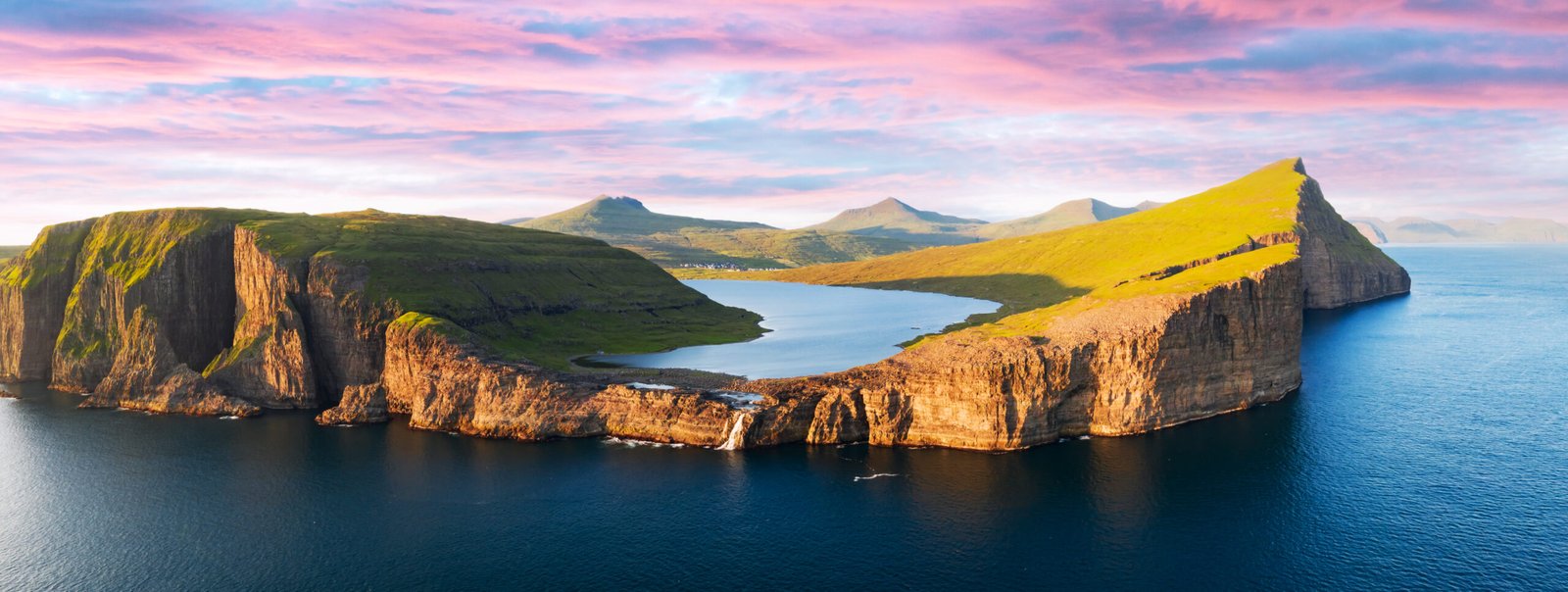
Sorvagsvatn lake on cliffs of Vagar island, Faroe Islands
The Faroe Islands have become an increasingly popular destination in recent years, driven partly by social media photographs of the sea cliffs at Gásadalur and the lake at Sørvágsvatn — which appears to float above the ocean due to an optical illusion from certain angles.
Getting there means flying to Vágar Airport (see above). Atlantic Airways operates regular connections from Copenhagen, Reykjavik, and several other European cities. The flight from London takes around two hours. Bring a weatherproof layer regardless of the season.
Accommodation ranges from the capital’s hotels to remote farmhouses. The tourism infrastructure has grown rapidly but the islands still feel genuinely remote — partly because they are.
The currency is the Faroese króna, pegged to the Danish krone. Danish banknotes circulate alongside Faroese ones; the coins are Danish.
The official tourism site is visitfaroeislands.com, which offers well-organised guidance on the islands’ geography, travel logistics, and culture. The Faroese government’s own English-language portal is at government.fo, which includes the political and legal status documents referenced in this article. For Faroese language background, the guide at faroeislands.fo is a useful starting point.
A Note on What the Faroe Islands Actually Are
After spending time with the history, what stays with you is how thoroughly the Faroese have managed to be themselves under conditions that should have made it impossible. Their language was officially erased for centuries and they kept it alive through song. Their parliament was abolished and reconstituted and ignored and they kept turning up to it. They voted for independence and had the result cancelled and negotiated for the next best thing and then kept expanding it, quietly, agreement by agreement.
They are 55,000 people on 18 windswept islands in the North Atlantic. They have their own language, their own flag, their own parliament, their own foreign trade policy, their own national football team, their own whale hunt, their own increasingly pointed opinions about Danish sovereignty, and their own terrifying airport.
Whether that eventually adds up to a country is, for now, still a question. But it does not particularly feel like it should be.
Sources: Britannica | Guide to Faroe Islands | NordiskPost | The Northern Voices | Faroese Government | Pulitzer Center | National Geographic | Vaisala | US State Dept 2025 Investment Climate Statement | The New World



 English