
The backstory
The story starts on the radio. In the week after Christmas 1954, Norwegian children could tune in to Barnetimen for de minste for a five-part musical about a small town where the police chief is gentle and the robbers live outside the gates. Store norske leksikon records that Thorbjørn Egner turned it into a book the next year, Folk og røvere i Kardemomme by, known in English as When the Robbers Came to Cardamom Town. Kardemomme is the Norwegian word for the spice.
The man and the town
Egner (1912 to 1990) grew up in the working-class Oslo district of Kampen and trained as an illustrator. According to a Cappelen Damm study guide, he worked for some years as a decorative painter and advertising artist. His three best-known children’s works are Karius og Baktus (1949), Klatremus og de andre dyrene i Hakkebakkeskogen (1953) and the Kardemomme book, according to Store norske leksikon’s Egner entry. He also wrote the songs, composing the Kardemomme melodies with Bjarne Amdahl, and the first songs appeared on the EP Kardemommeviser in 1955.
The town’s look comes from Morocco. Store norske leksikon says the drawings were shaped by Egner’s 1949 study trip to Fez, while the social order resembles a small Danish town. A Norwegian publisher’s English-language description notes that donkeys and camels walk the streets, and possibly a lion. The lion belongs to the robbers.
Those robbers are Kasper, Jesper and Jonathan. The plot turns on a fire in the tower of the old wise man Tobias. The robbers help put it out, and the town takes them in. They get honest trades, and Jonathan becomes the baker. The book’s best-known passage is the Kardemomme law, which the police chief recites: don’t bother other people, be decent and kind, and otherwise do as you please. The criminologist Nils Christie credited Egner with a significant contribution to criminology in Norway, partly through this book.
The commercial afterlife was large. The play opened at Nationaltheatret in December 1956. By 2020 the Norwegian edition had been printed 372,000 times and the book had been sold for translation into more than 20 language areas, per Store norske leksikon. A model of the town opened in Kristiansand Zoo in 1991. Egner died in 1990, after the park was under construction but before it was finished.
None of the sources consulted for this article records why Egner named the town after a spice. A Norwegian reader needs no explanation, since kardemomme is what goes in the buns. The Fez connection is a different matter. One theory of how cardamom reached Scandinavia runs through the Moors, and a Moroccan-looking town named after cardamom invites the thought. No source links the two, and the overlap may be coincidence.
An Indian spice in the far north
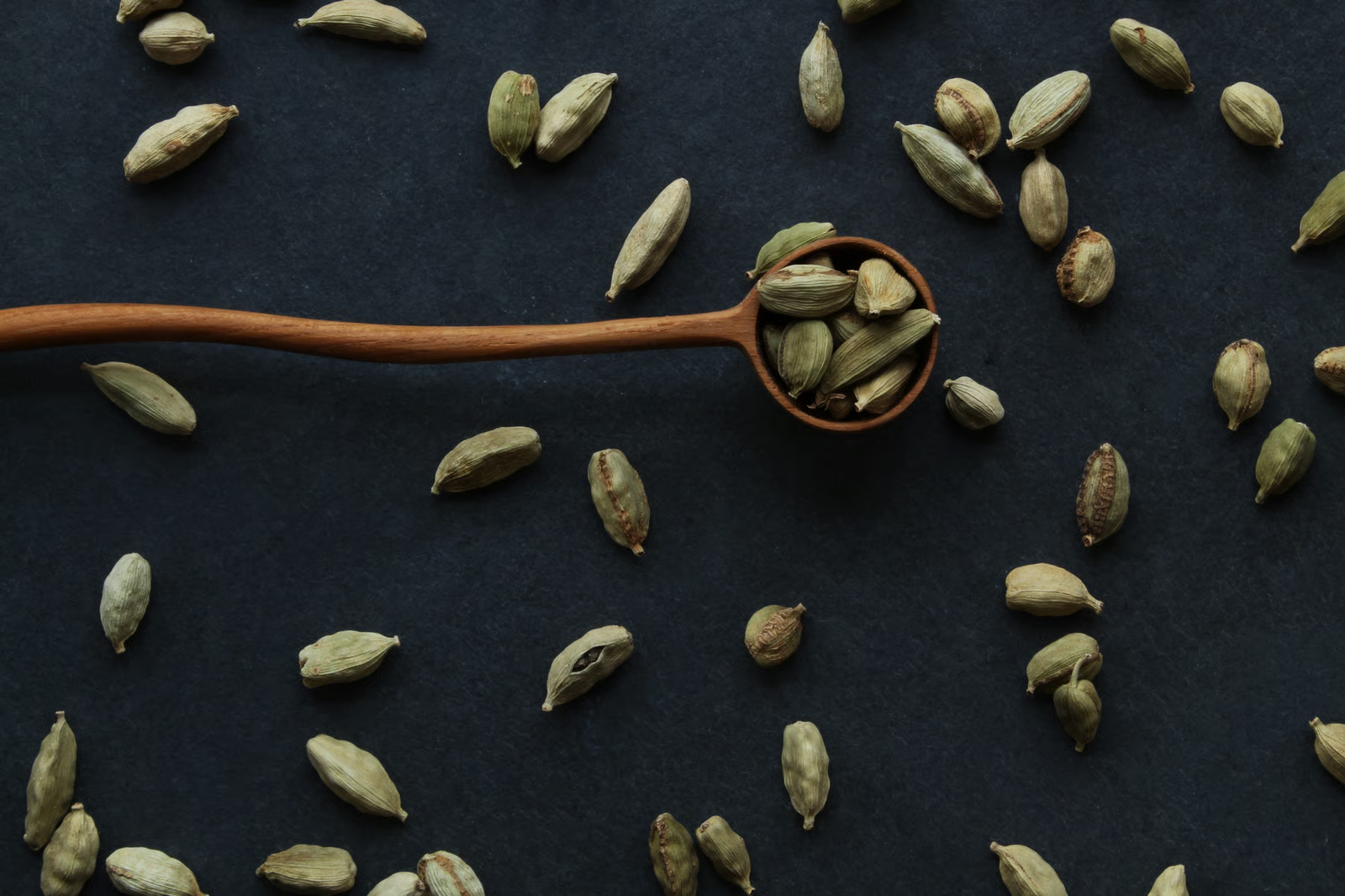
Green cardamom comes from the Cardamom Hills of southern India. Cook’s Illustrated calls it the third most expensive spice in the world, after saffron and vanilla. Outside India it is mostly a spice of Arab, Iranian and North African cooking. It is also, on United Nations figures cited by the same magazine, a Nordic obsession: Sweden uses about 18 times more per person than the median country, and Norway almost 30 times more.
Nobody knows how it got there. Two explanations compete.
The popular one credits the Vikings, who supposedly found cardamom in the bazaars of Constantinople around 1,000 years ago. Cook’s Illustrated says many Swedes believe this, according to cookbook author Johanna Kindvall. The legend is robust enough to turn up in commercial product copy. A Toro spice listing on matoppskrift.no states it as fact.
The culinary archaeologist Daniel Serra disagrees. He finds no archaeological evidence and no Viking or Icelandic literary evidence that imported spices were used in Scandinavian kitchens during the Viking Age. He favors the Moors, who established themselves in Iberia from the eighth century. In his reading, the first Scandinavian mention of cardamom is a 13th-century cookbook, the Libellus de Arte Coquinaria, whose recipes are almost identical to Moorish ones, as Cook’s Illustrated reports.
The Viking story is better marketing, and Serra’s is better evidence. Neither explains why the spice stuck. The Herb Society of America points to a likelier mechanism: as sea routes cut out middlemen, European spice prices fell, and spices came within reach of the middle class for special occasions. A spice tied to occasions tends to stay tied to them. Kindvall describes cardamom as a “memory smell” for Scandinavians. Once a flavor means holidays and the coffee table, each generation learns it as the taste of home, whatever the Vikings did or did not carry.
What it goes into
| Country | Cardamom bakes | Notes |
|---|---|---|
| Sweden | Kardemummabullar (buns), kardemummabröd (bread), kardemummakaka (cake) | Buns and bread are eaten with coffee or tea, per Wikipedia |
| Norway | Hveteboller, kardemommesnurrer, julekake | Julekake is a Christmas bread with raisins and candied fruit, per Food Republic |
| Denmark | Fastelavnsboller | Soft buns from cardamom dough, filled with cream or jam and eaten in Lent (Food Republic) |
| Finland | Pulla (also nisu), korvapuusti | Braided loaf or rolled bun; Food52 says the only two constants are cardamom in the dough and coffee alongside |
Finland takes the habit furthest. A family profile in BG Independent News reports that in Finland, serving coffee without pulla counts as “bare coffee.” The spice also leaves the bakery: Food Republic lists rice pudding, pickling liquids and mulled wine among its uses, and Cook’s Illustrated mentions Swedish meatballs.
Three recipes
Whole pods beat ground cardamom. The Swedish baking writer Maud Onnermark advises crushing the seeds, because the aroma fades quickly once the spice is ground. A rough conversion from Beyond Kimchee: 30 pods equal about 1 tablespoon of ground cardamom, so 10 pods make about 1 teaspoon. Crack the pods, tip out the black seeds and crush them in a mortar or under a heavy pan.
Slice and bake cardamom cookies
Makes about 35. The easiest of the three.
- 150 g soft butter
- 100 g sugar
- 1 egg yolk
- 250 g plain flour
- 1½ tsp ground cardamom (seeds from about 15 pods)
- A pinch of salt
Beat the butter and sugar until smooth, then mix in the yolk. Stir in the flour, cardamom and salt until a dough forms. Shape into two logs about 4 cm thick, wrap and chill for an hour. Heat the oven to 175 °C. Slice the logs about 5 mm thick, lay the rounds on a lined tray and bake for 10 to 12 minutes, until the edges turn pale gold.
One bowl cardamom cake
Serves 8 to 10. A Swedish sockerkaka with the spice added.
- 3 eggs
- 200 g sugar
- 150 g butter, melted and cooled
- 100 ml milk
- 200 g plain flour
- 2 tsp baking powder
- 2 tsp ground cardamom (seeds from about 20 pods)
- A pinch of salt
Heat the oven to 175 °C and grease a 22 cm round tin or a 1.5 litre loaf tin. Whisk the eggs and sugar for about 3 minutes, until pale and thick. Stir in the butter and milk. Fold in the flour, baking powder, cardamom and salt, and stop as soon as no dry flour shows. Bake 40 to 50 minutes, until a skewer comes out clean. Dust with icing sugar once cool. Anyone who wants a lighter, whisked-egg-white version can try the bundt cake from the book Fika, published by KCRW.
Cardamom buns
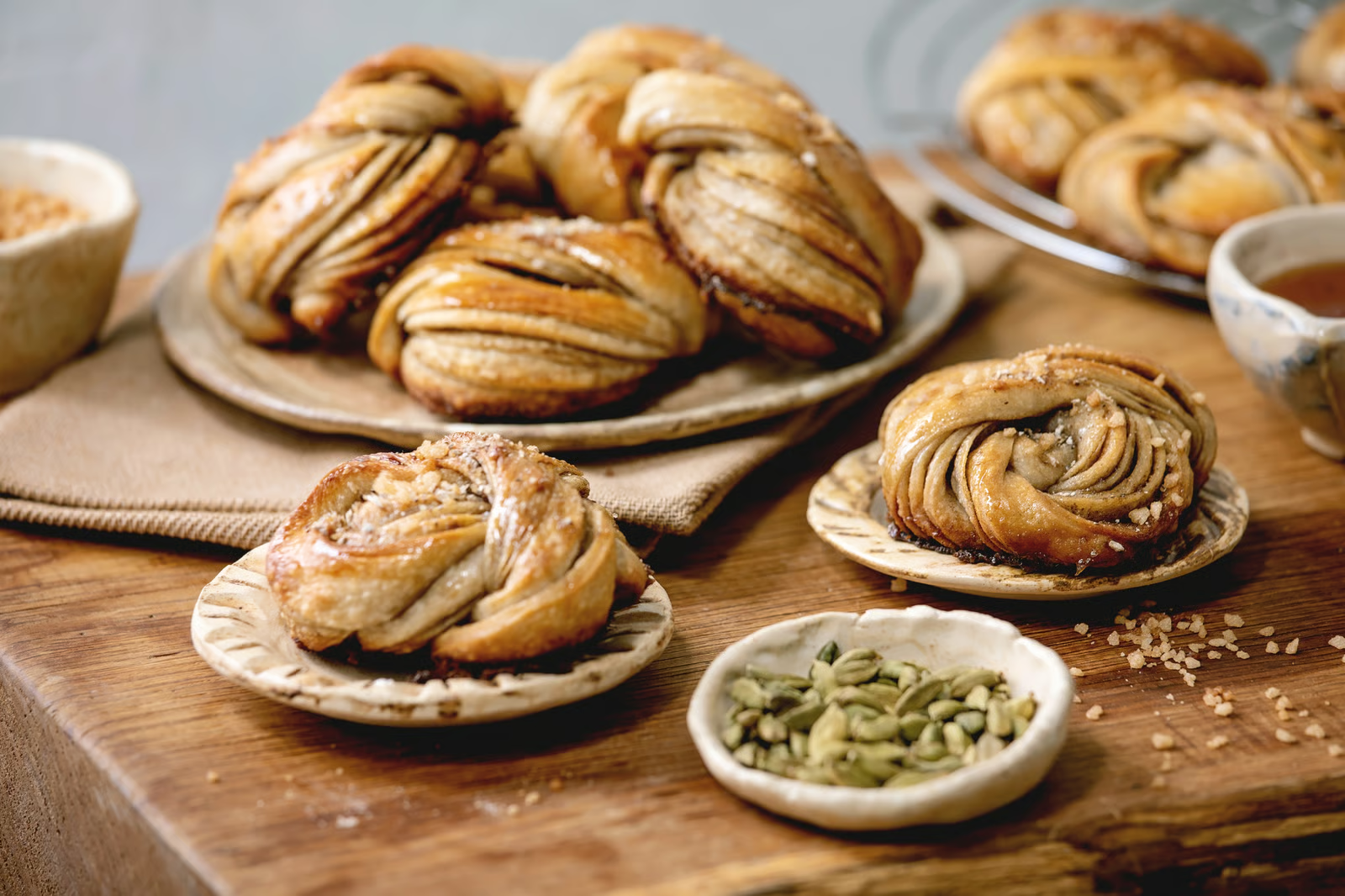
Makes about 12. This is the step up, because it uses yeast. It is a halved and simplified version of the TINE test kitchen recipe, which makes about 16 from a double batch.
For the dough:
- 75 g butter
- 250 ml whole milk
- 25 g fresh yeast (about 8 g instant)
- ¼ tsp salt
- 50 g sugar
- ¾ tsp ground cardamom
- 1 egg
- About 360 g plain flour (6 dl), with some held back
For the filling and top:
- 50 g soft butter
- 40 g sugar
- 1 tsp ground cardamom
- 1 beaten egg
- Pearl sugar
Melt the butter in a pan, add the milk and warm it to fingertip temperature, about 37 °C. Dissolve the yeast in a splash of it, then pour everything together. Add the salt, sugar, cardamom, egg and most of the flour. Work to a soft, slightly loose dough, adding the held-back flour only if it sticks badly. TINE’s tip is to use as little flour as possible. Cover and leave to rise for 30 to 40 minutes.
Mix the soft butter, sugar and cardamom for the filling. Roll the dough into a rectangle of roughly 30 by 40 cm and spread the filling over it. Roll up from the long side and cut into about 12 slices. Place the slices cut side down on a lined tray, cover and let them rise again for 30 to 40 minutes. Brush with beaten egg and sprinkle with pearl sugar. TINE bakes its buns at 250 °C for 7 to 8 minutes. Home ovens vary, so check the first tray early.
The last robber
Egner made Jonathan, the least respectable of the robbers, the town baker. In a place named for cardamom, the menu is easy to guess.
Sources
- Store norske leksikon: Folk og røvere i Kardemomme by
- Store norske leksikon: Thorbjørn Egner
- Store norske leksikon: Kardemomme
- Wikipedia: When the Robbers Came to Cardamom Town
- Cappelen Damm: Egner study guide
- NORLA: When the Robbers Came to Cardamom Town
- Cook’s Illustrated: Cardamom: How Did It Become Scandinavia’s Favorite Spice?
- America’s Test Kitchen: same article, with Daniel Serra’s comments
- Food Republic: How Indian Cardamom Became a Scandinavian Staple Spice
- Herb Society of America: Cardamom: Tropical Spice and Scandinavian Staple
- Matoppskrift.no: Toro Krydderiet Kardemomme malt
- Wikipedia: Cardamom bread
- Food52: Finnish cardamom bread, pulla and nisu
- BG Independent News: Finnish coffee table staple
- TINE: Kardemommesnurrer
- KCRW Good Food: Kardemummakaka
- Femina: Kardemummakakor, knapriga och lättbakade
- Beyond Kimchee: Pulla




 English