
What the lights are, and what people made of them
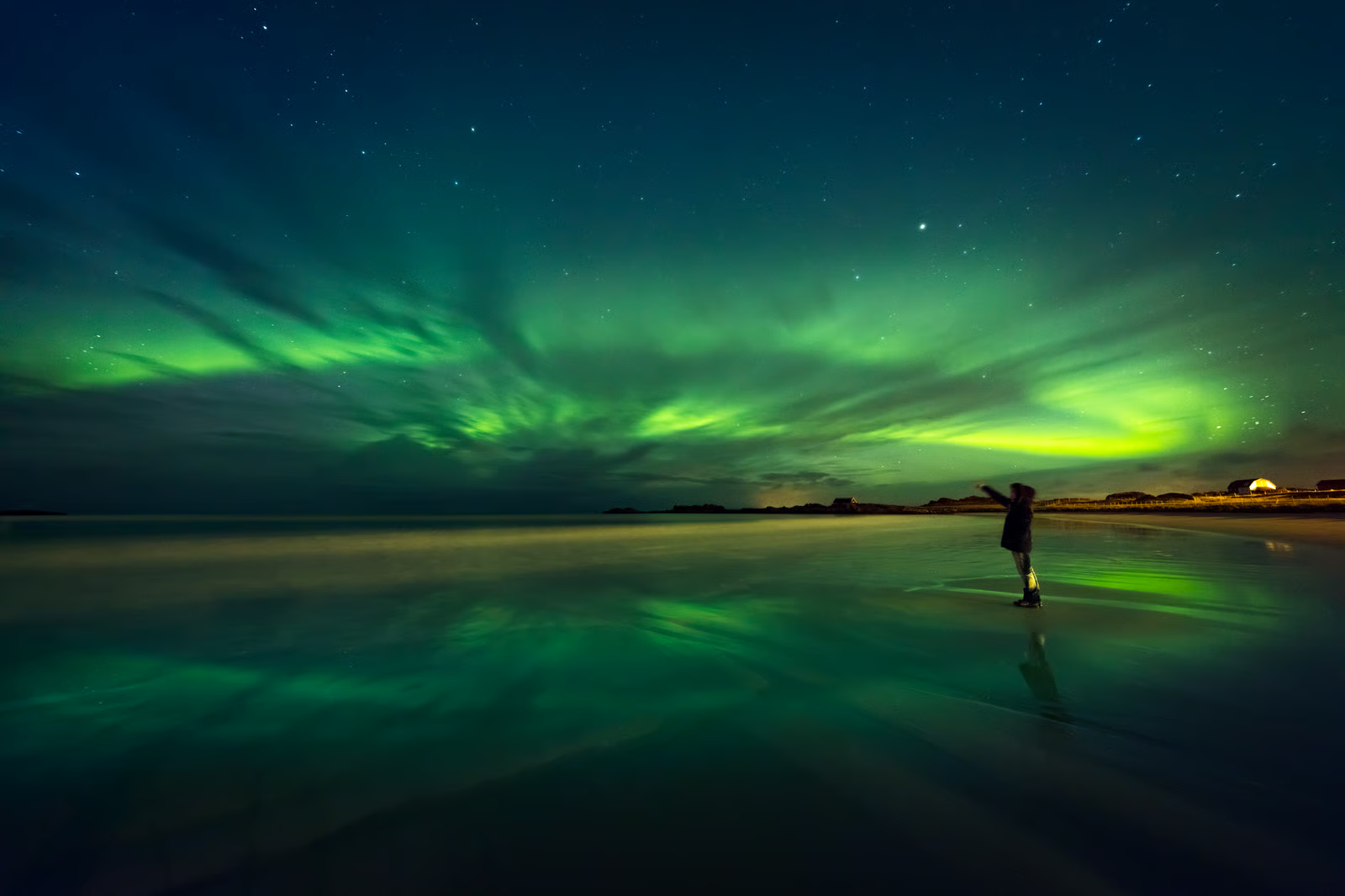
The aurora is sunlight’s distant relative. Charged particles streaming off the Sun are steered by Earth’s magnetic field toward the polar regions, where they collide with atoms in the upper atmosphere and release the energy as light. The first person to work this out in detail was a Norwegian, Kristian Birkeland, who in 1899 built the world’s first auroral observatory on Mount Haldde, above the fjord at Alta. He proposed that particles from the Sun were guided to the poles by the magnetic field, and he fired electrons at a magnetised brass sphere in his laboratory to produce small glowing rings at its poles. Mainstream physicists dismissed the idea, and satellite magnetometer data only confirmed it in 1967. Norwegians now carry his terrella experiment in their wallets, on the 200-krone note.
People saw the lights long before anyone could explain them. A Babylonian clay tablet from around 567 BCE is usually cited as the oldest written record, and Aristotle described “moving torches” in the night sky around 330 BCE. The Norwegian schoolbook known as the King’s Mirror, written around 1230 for a young prince, has the son ask about what “the Greenlanders call the northern lights”, so Greenland’s sky was already part of the European conversation eight centuries ago. In 1619 Galileo and his circle were using the name aurora borealis. He was working in Italy, where the lights are rare and mostly red, which is why the name means “northern dawn”. It was a good guess for a southern observer and a poor description of the green curtains seen in Finnmark.
Folklore ran in darker directions. Swedish tradition imagined angels flinging burning fatwood at each other, and some Sámi communities feared the aurora might take or kill their children. One popular claim deserves correction. The Sámi word guovssahas is often glossed as “the light you can hear”, but Ole Henrik Magga, the first president of the Sámi Parliament, told Visit Northern Norway that it more likely derives from guovssu, dawn, which makes it much closer to Galileo’s name than to a soundtrack. The “audible aurora” line shows up mostly in non-Sámi writing and in brochures.
The 2026-27 season
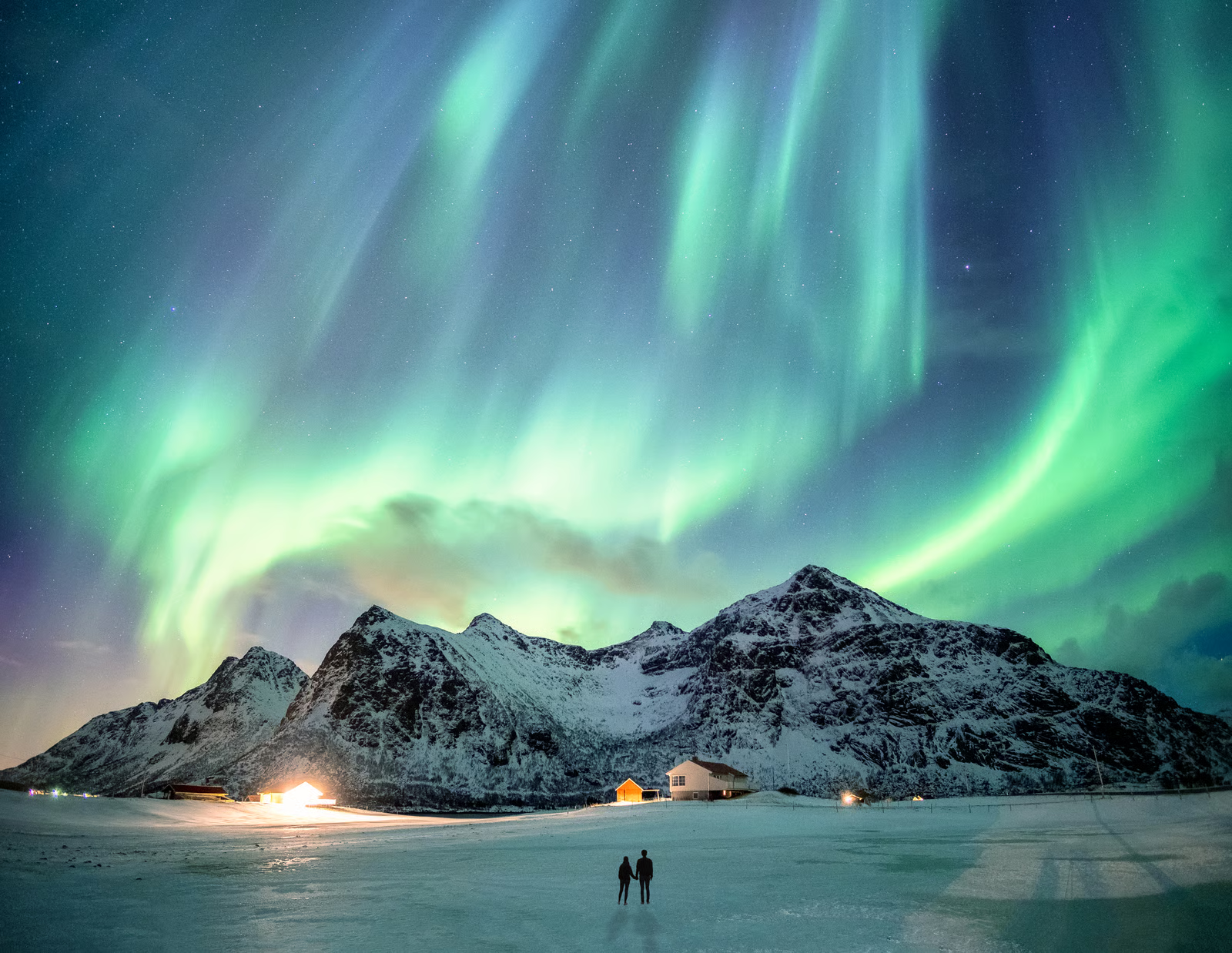
Solar Cycle 25 was declared to have reached maximum in October 2024, and the Sun is now in the declining phase. That does not mean quiet skies. The cycle’s third-strongest storm so far reached G4 (severe) on 11 November 2025, after G5 and G4 storms in 2024. Space weather scientist Ledvina, quoted by Time and Date, says fewer storms are expected in 2026, but the odds of a rare extreme event may actually be higher, and coronal holes produce recurring wind streams that can be anticipated with NOAA’s 27-day outlook.
For a trip planner, the practical result is that solar activity is helpful but secondary. Latitude, cloud and darkness decide most nights. Everything below is therefore organised around places where the sky is dark and clouds are less common, and where a bus pass or a rental car is enough.
Norway: Tromsø by bus, and the weather rule
Tromsø sits under the auroral oval and has more dark-sky spots within city bus range than any comparable town. Visit Tromsø lists Telegrafbukta, a beach on the southern tip of the island reached by bus 33, and Prestvannet, a lake on the island’s high ground reached by bus 28 or 40. On Kvaløya, the fjord head at Ersfjordbotn takes bus 42 to Eidkjosen and then bus 425, with the 425 running Monday to Saturday. A local journalist’s guide adds that bus timetables thin out sharply in the evenings and that wind direction matters: northwest winds tend to bring cloud to the city, and south winds clear it. Telegrafbukta and Prestvannet have moderate light pollution but are still good enough on active nights.
Visit Northern Norway’s own advice is to follow the weather rather than a fixed spot: mild, snowy weather often clears the inland Sámi heartlands or the head of a fjord near Narvik, while dry easterlies favour the outer coasts of Senja and Vesterålen. A rental car turns that advice into a plan. A bus pass does not, but it covers the city fringe.
Sweden: Abisko and a train in transition
Abisko, 200 km above the Arctic Circle, has a microclimate known as the “blue hole”. Chad Blakley of Lights Over Lapland told National Geographic that the dominant wind meets the Norwegian mountains and leaves a small gap in the clouds over the village. The Swedish Tourist Association says the aurora is as likely on the Nuolja mountain as down at the tourist station, so the ticketed Aurora Sky Station is optional. The village itself is dark enough, and the national park is free to walk in.
Getting there by rail is the draw, and it is currently awkward. The direct Stockholm-Narvik night train was cut in April 2026, leaving passengers to change at Boden, and the cut hit Abisko’s tourist station bookings hard. Sweden’s transport agency has since awarded SJ the contract to run a through service from December 2026, and SJ released tickets on 19 October for travel from 13 December 2026 to 10 January 2027. For late November, the operator Snälltåget runs a one-off Malmö-Stockholm-Narvik night train (departing 23 November, returning from Narvik on 27 November) that stops at Abisko.
Finland: the far north, and a warning about Rovaniemi
According to the Finnish Meteorological Institute, as quoted by Visit Finland, Kilpisjärvi sees the lights on about three of every four clear nights in the dark season, and Utsjoki about ten percentage points fewer. Both are small and remote. The northernmost airport is at Ivalo, and Finnair flies to Ivalo, Kittilä and Rovaniemi. Kilpisjärvi is roughly five hours from Rovaniemi, so a car or the daily bus is part of the plan. The FMI’s aurora alerts and space weather service are the best free forecasts in the region.
Rovaniemi and the glass-igloo resorts around Saariselkä are the heart of Lapland’s packaged aurora trade. They sit well south of Utsjoki and Kilpisjärvi, and a night in an igloo adds heat and a view, not extra aurora.
Iceland: forecasts that include cloud
The Icelandic Met Office publishes the most useful single page in the Nordic region, because it pairs the aurora forecast with a national cloud map. It grades visibility from 0 to 9, and a 3 is often spectacular under clear skies. Iceland Review lists Grótta lighthouse, the Grandi area, the Old Harbour and Öskjuhlíð hill as places to watch from in Reykjavík, and Þingvellir is about 45 minutes away by car. Iceland’s cloud forecasts are fickle, so the practical rule is to be ready to drive to wherever the map shows clear sky.
Faroe Islands: an add-on, not a reason to go
The Faroese aurora is real, and Visit Faroe Islands suggests the northern islands such as Viðoy and the village of Viðareiði for the darkest skies. But the archipelago’s weather is a poor match for aurora planning. One UK specialist guide says there are more reliable destinations if the lights are the aim, and autumn storms regularly cancel flights at Vágar, the only airport. The islands suit travellers who want the scenery and would treat the aurora as a bonus.
Side note about Denmark: the northern lights are usually not visible at lower latitudes.
Greenland: the farthest, and about to get easier
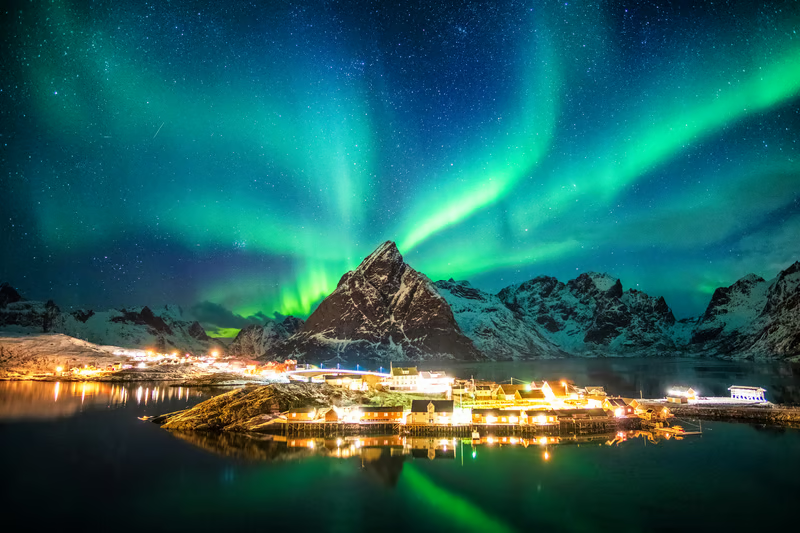
Visit Greenland says Kangerlussuaq lies on the auroral oval and has “more than 300 nights of clear skies per year” (a figure that reads like marketing, but the town’s dry inland position is a genuine advantage). Air Greenland flies there from Copenhagen in about 4.5 hours. The country’s transport has just changed. Nuuk’s new international airport opened in November 2024, Qaqortoq’s in April 2026, and Ilulissat’s on 29 October 2026, which gets a weekly nonstop from Copenhagen every Wednesday. There are no roads between towns, so every hop is a flight or a helicopter, and the season closes early. A UK operator warns that April is often too bright for the lights.
Chart: where, how, and what it costs
The cost ratings below run from 1 (cheapest) to 5 (most expensive) and are editorial judgements for a traveller starting in London, anchored on the sourced figures in the last column. Fares move daily, so the links point to the airline or timetable pages for current prices.
| Base | Flights and rail | On the ground | Flights | Daily costs | Sourced anchors |
|---|---|---|---|---|---|
| Tromsø, Norway | SAS, Norwegian, BA, easyJet, Wizz from London | City buses to Telegrafbukta, Prestvannet and Ersfjordbotn | 2 | 4 | Return fares from London from £99, averaging £270; a basic restaurant meal about NOK 250-280, a pint about NOK 103 |
| Abisko, Sweden | SJ night train Stockholm to Abisko; flights to Kiruna | Village is walkable; park paths are free | 2 | 3 | Rail is the main cost; a guided Sky Station night was £249 from the UK in 2023-24, so skipping the package is the saving |
| Kilpisjärvi and Utsjoki, Finland | Finnair via Helsinki to Ivalo, Kittilä or Rovaniemi | Rental car or daily bus; long distances | 3 | 3 | Kilpisjärvi is about 5 hours from Rovaniemi by road; FMI alerts are free |
| Reykjavík and Þingvellir, Iceland | Icelandair, easyJet, BA from London | Rental car for dark sites; Grótta is close to town | 1 | 4 | Average return £141, cheapest in January |
| Vágar and the northern isles, Faroe Islands | Atlantic Airways and SAS; Icelandair is seasonal and stops in late October | Rental car; weather can ground flights | 3 | 3 | One fare tracker gives a wide $300-1,200 return range |
| Kangerlussuaq, Nuuk and Ilulissat, Greenland | Air Greenland from Copenhagen; Ilulissat nonstop on Wednesdays | Domestic flights only; no road network | 5 | 5 | One-way Copenhagen to Kangerlussuaq from DKK 3,388 (about €450); a packaged nine-night trip was £3,515 per person |
The cheapest sensible aurora trip is Iceland or Tromsø in the shoulder months. The most reliable for a few nights without a car is Tromsø or Abisko. The most remote and most expensive is Greenland, which is also the one with the strongest sense of being somewhere else.
What to skip, and why
The aurora does not cost more in a glass igloo. The same sky is visible from a lay-by or a lake shore outside Tromsø, and a local Tromsø writer says tours matter mainly when the weather in town is bad, which a rental car or a bus to the next fjord can also solve. The Sunvil Abisko package above is a useful reminder of what the packaging adds: the same chair lift, a guide and a station that can be reached on foot.
Three habits are worth the effort instead. Check the cloud forecast before the aurora forecast, since a strong storm behind thick cloud shows nothing. Plan at least three nights in one place. And pack a high-visibility vest and ice cleats for walks along dark roads, as Tromsø’s aurora watchers recommend.
Sources
- Windridge, M. (2017). “Who was Kristian Birkeland?”.
- Norway’s centuries-long watch on the northern lights. San Juan Daily Star.
- Kristian Birkeland. Wikipedia.
- Burns, T. Aurora history column. Delaware Gazette.
- Aurora Borealis: the folklore of the northern lights. Folklore Thursday.
- UNIS. Aurora lecture notes, AGF216.
- Visit Northern Norway. Everything you need to know about northern lights and See the northern lights in walking distance from Tromsø.
- Space.com. Will 2026 still bring strong auroras?
- Time and Date. Aurora 2026.
- Visit Tromsø. Top 8 places to explore on foot, ski or snowshoe.
- National Geographic. The Swedish overnight train to the northern lights.
- Swedish Tourist Association. Northern lights in Sweden.
- Norrbottens-Kuriren / NSD. 500 gästnätter bort i Abisko efter halverad tågtrafik.
- SJ press release (25 June 2026). SJ tilldelas nattågstrafiken till övre Norrland och Umeå.
- Snälltåget. Aurora night train booking page.
- Visit Finland. Heading to Finland to see the northern lights.
- Finnair. Ten questions about the northern lights.
- Icelandic Met Office via Golden Circle Day Tours. Best aurora forecast apps for Iceland; Grapevine, aurora forecast scale; Iceland Review, How to read a northern lights forecast.
- Visit Faroe Islands. Northern lights guide; Guide to Faroe Islands, Flights; Local.fo, Strong winds disrupt air travel at Vágar.
- Visit Greenland. Kangerlussuaq; Air Greenland, route map and fares; Euronews, Ilulissat airport opens.
- Fare and cost references: Omio, Expedia, Cheapflights, Ratepunk, MyLifeElsewhere, Sunvil, Baltic Travel Company.




 English